
For example, the prefix UN- means the opposite:
- happy 🙂
- unhappy 🙁
The prefix OVER- means “too much:”
- spend –> overspend (spend too much money)
Here are 10 common prefixes in English with example words and sentences:
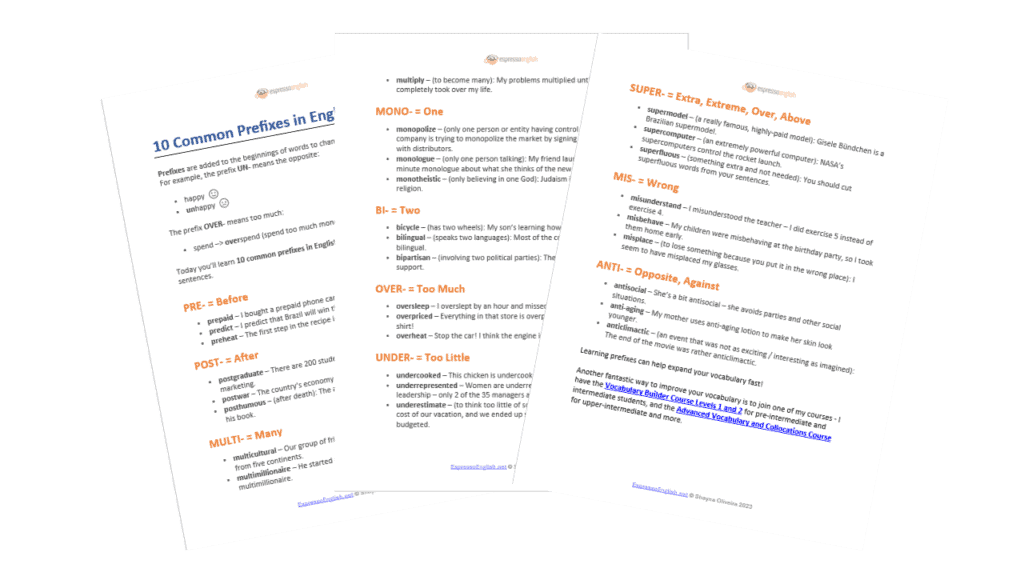
PRE- = before
- prepaid – “I bought a prepaid phone card with $20 worth of credit.”
- predict – “I predict that Brazil will win the next World Cup.”
- prevent – “Seat belts can prevent serious injuries if you get into a car accident.”
POST- = after
- postgraduate – “There are 200 students in the postgraduate program in marketing.”
- postwar – “The country’s economy struggled during the postwar period.”
- posthumous – (after death): “The author received a posthumous award for his book.”
MULTI- = many
- multicultural – “Our group of friends is quite multicultural – we know people from five continents.”
- multimillionaire – “He started a successful business and became a multimillionaire.”
- multiply – (to become many): “My problems multiplied until they completely took over my life.”
MONO- = one
- monopolize – (only one person or entity having control of something): “That company is trying to monopolize the market by signing exclusivity contracts with distributors.”
- monologue – (only one person talking): “My friend launched into a 15-minute monologue about what she thinks of the new president.”
- monotheistic – (only believing in one God): “Judaism is a monotheistic religion.”
BI- = two
- bicycle – (has two wheels): “My son’s learning how to ride a bicycle.”
- bilingual – (speaks two languages): “Most of the company managers are bilingual.”
- bipartisan – (involving two political parties): “The law has bipartisan support.”
OVER- = too much
- oversleep – “I overslept by an hour and missed my first class.”
- overpriced – “Everything in that store is overpriced. They charge $60 for a T-shirt!”
- overheat – “Stop the car! I think the engine is overheating.”
UNDER- = too little
- undercooked – “This chicken is undercooked; I don’t think it’s safe to eat.”
- underrepresented – “Women are underrepresented in our company leadership – only 2 of the 35 managers and directors are women.”
- underestimate – (to think too little of something) – “I underestimated the cost of our vacation, and we ended up spending far more than we’d budgeted.”
SUPER- = extra, extreme, over, above
- supermodel – (a really famous, highly-paid model): “Gisele Bündchen is a Brazilian supermodel.”
- supercomputer – (an extremely powerful computer): “NASA’s supercomputers control the rocket launch.”
- superfluous – (something extra and not needed): “You should cut superfluous words from your sentences.”
MIS- = wrong
- misunderstand – “I misunderstood the teacher – I did exercise 5 instead of exercise 4.”
- misbehave – “My children were misbehaving at the birthday party, so I took them home early.”
- misplace – (to lose something because you put it in the wrong place): “I seem to have misplaced my glasses.”
ANTI- = opposite, against
- antisocial – “She’s a bit antisocial – she avoids parties and other social situations.”
- anti-aging – “My mother uses anti-aging lotion to make her skin look younger.”
- anticlimactic – (an event that was not as exciting / interesting as imagined): “The end of the movie was rather anticlimactic.”