
Are you trying to pronounce each word clearly and perfectly when you speak English?
Warning: Native English speakers DON’T do this!
Natural spoken English contains reductions – those are sounds that change and disappear when spoken at normal speed. This sometimes makes it hard for English learners to understand.
- Like instead of saying: “What are you going to do?”
- We say: “Whatcha gonna do?”
Today you’ll learn and practice 10 of the most common reductions in fast spoken English – this pronunciation practice will help you speak more naturally AND understand native speakers more easily.
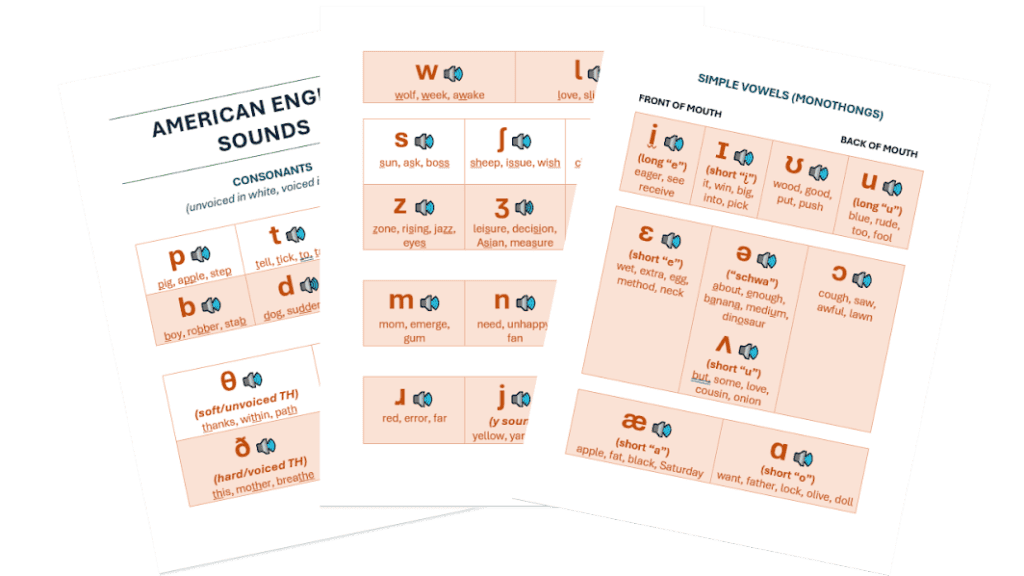
Before we get started, I’ve got a free gift for you – it’s my pronunciation guide to all the sounds of American English! This guide covers all the consonants and vowel sounds we use, with practice words and audio so you can listen and repeat.
Now let’s learn these common reductions in English:
1. Going to → gonna
Used for future plans or intentions.
✅ Examples:
- I’m gonna grab some coffee — want anything?
- They’re gonna call you later.
- It’s gonna rain tonight.
Not that we only do this when “going to” is followed by a verb. So in the sentence “I’m going to London tomorrow,” we don’t say “I’m gonna London” – it’s not correct. “Going to” becomes gonna only before a verb, so we can say “I’m gonna fly to London tomorrow.”
2. Want to → wanna
Used when expressing desire.
✅ Examples:
- Do you wanna join us?
- I wanna learn how to cook.
- She doesn’t wanna go out tonight.
3. Have to → hafta
Used for necessity or obligation.
✅ Examples:
- I hafta finish this project today.
- You hafta see this — it’s amazing!
- We hafta be there by 5.
4. Has to / Had to → hasta / hadda
“Has to” = hasta, “Had to” = hadda
✅ Examples:
- He hasta leave early for work.
- She hasta check her schedule first.
- I hadda cancel the meeting last minute.
- They hadda get their car fixed.
5. Got to → gotta
Used to express something that must be done.
✅ Examples:
- I gotta go!
- You gotta try this cake.
- We gotta talk about your trip.
6. Should have → shoulda
Could have → coulda
Would have → woulda
✅ Examples:
- I shoulda studied more for the test.
- You coulda called me, and I woulda helped!
- He shouldn’a done that.
(shouldn’t have)
7. Let me → lemme
Used in offers or actions:
✅ Examples:
- Lemme help you with that.
- Lemme know if you need anything.
- Lemme think about it.
8. Give me → gimme
Used for informal requests.
✅ Examples:
- Gimme a second.
- Gimme your phone number.
- Gimme a break!
This is very informal and it’s not super polite; parents often have to teach their kids to say “Can I please have a snack?” instead of “gimme a snack” – but you do hear it among friends.
9. What are you → whatcha
What do you → whatcha/whaddaya
Casual, fast questions.
✅ Examples:
- Whatcha thinking about?
- Whatcha gonna do?
- Whatcha/Whaddaya wanna eat tonight?
10. Do you → d’ya
Don’t you → doncha
Did you → didja
Common in fast questions.
✅ Examples:
- D’ya wanna come with us?
- Doncha love this song?
- Didja see that?
Reductions in English are very common!
Now you know 10 of the most common reductions in English — and once you start hearing them, you’ll notice them everywhere.
If you’d like to improve your pronunciation and practice speaking more naturally, come join me in the Pronunciation + Shadowing Courses!
🎧 The lessons help you listen, repeat, and train your mouth to speak English smoothly and accurately — just like a native speaker.
Thanks for practicing with me today, and I’ll talk to you next time!