
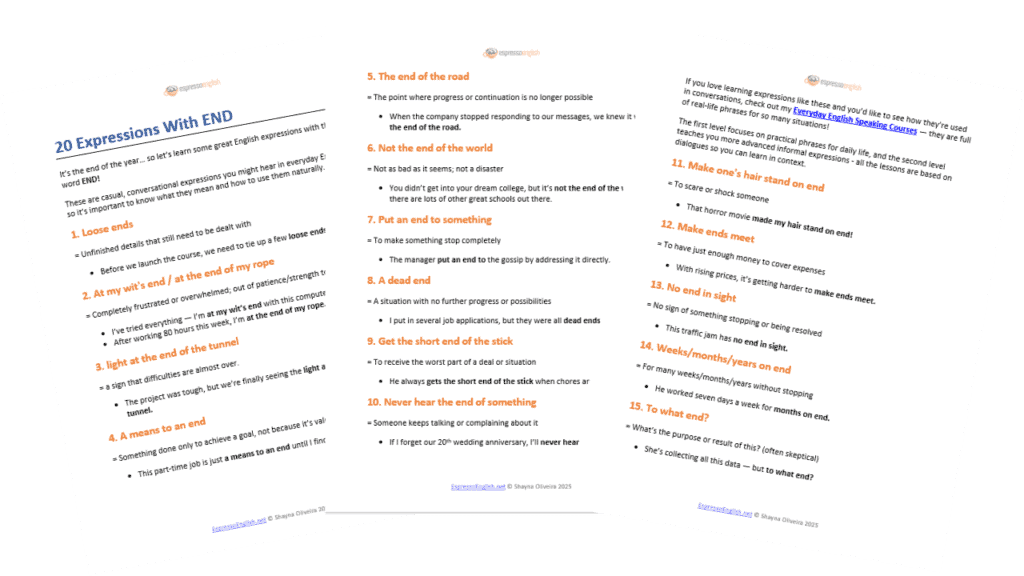
It’s the end of the year… so let’s learn some great English phrases with the word END!
These are casual, conversational expressions you might hear in everyday English – so it’s important to know what they mean and how to use them naturally.
Loose ends
= Unfinished details that still need to be dealt with
- Before we launch the course, we need to tie up a few loose ends.
At my wit’s end / at the end of my rope
= Completely frustrated or overwhelmed; out of patience/strength to continue
- I’ve tried everything — I’m at my wit’s end with this computer problem.
- After working 80 hours this week, I’m at the end of my rope.
light at the end of the tunnel
= a sign that difficulties are almost over.
- The project was tough, but we’re finally seeing the light at the end of the tunnel.
A means to an end
= Something done only to achieve a goal, not because it’s valuable itself
- This part-time job is just a means to an end until I find something better.
The end of the road
= The point where progress or continuation is no longer possible
- When the company stopped responding to our messages, we knew it was the end of the road.
Not the end of the world
= Not as bad as it seems; not a disaster
- You didn’t get into your dream college, but it’s not the end of the world – there are lots of other great schools out there.
Put an end to something
= To make something stop completely
- The manager put an end to the gossip by addressing it directly.
A dead end
= A situation with no further progress or possibilities
- I put in several job applications, but they were all dead ends.
Get the short end of the stick
= To receive the worst part of a deal or situation
- He always gets the short end of the stick when chores are assigned.
Never hear the end of something
= Someone keeps talking or complaining about it
- If I forget our 20th wedding anniversary, I’ll never hear the end of it!
Make one’s hair stand on end
= To scare or shock someone
- That horror movie made my hair stand on end!
Make ends meet
= To have just enough money to cover expenses
- With rising prices, it’s getting harder to make ends meet.
No end in sight
= No sign of something stopping or being resolved
- This traffic jam has no end in sight.
Weeks/months/years on end
= For many weeks/months/years without stopping
- He worked seven days a week for months on end.
To what end?
= What’s the purpose or result of this? (often skeptical)
- She’s collecting all this data — but to what end?
End up (phrasal verb)
= To reach a final state or destination (often unexpected)
- We ended up staying in a tiny village off the map.
End game
= The final stage of a process, often one with strategy or consequences
- What’s your end game with this business idea?
Burn the candle at both ends
= overwork yourself; to do too much without rest.
- She’s been studying all night and working all day — she’s burning the candle at both ends.
At the end of the day
= when everything is considered; in conclusion.
- At the end of the day, what matters most is your health.
End on a high/sour note
= To finish something positively (high) or negatively (sour)
- The concert ended on a high note with a standing ovation.
- The meeting ended on a sour note after the argument.
I bet you didn’t know the word “end” could be used in so many different ways – but now you know 20 new expressions… and what better time to learn them than at the end of the year!
You can end the year on a high note by joining my Everyday English Speaking Course and taking your speaking skills to the next level, one lesson at a time.