“Good” and “bad” are two of the most common words in English – but if you use them all the time, your English can start to sound basic repetitive.
Instead of saying “The movie was good,” you could say it was fantastic.
Instead of saying “The service was bad,” you could say it was terrible — or even a disaster.
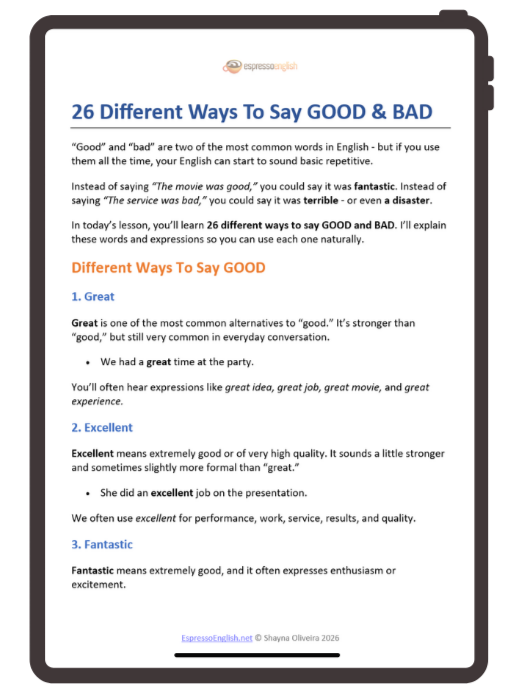
In today’s lesson, you’ll learn 26 different ways to say GOOD and BAD. I’ll explain these words and expressions so you can use each one naturally.
Make sure to download today’s free lesson guide!
Different Ways To Say GOOD
1. Great
Great is one of the most common alternatives to “good.” It’s stronger than “good,” but still very common in everyday conversation.
- We had a great time at the party.
You’ll often hear expressions like great idea, great job, great movie, and great experience.
2. Excellent
Excellent means extremely good or of very high quality. It sounds a little stronger and sometimes slightly more formal than “great.”
- She did an excellent job on the presentation.
We often use excellent for performance, work, service, results, and quality.
3. Fantastic
Fantastic means extremely good, and it often expresses enthusiasm or excitement.
- The concert last night was fantastic!
If you say something was fantastic, you were very impressed by it.
4. Amazing
Amazing means extremely good or impressive.
- The view from the top of the mountain was amazing.
In casual English, we use amazing very frequently for experiences, food, places, performances, and lots of other things we really like.
5. Outstanding
Outstanding means exceptionally good – noticeably better than average.
- He received an award for his outstanding performance.
This word is especially common when talking about someone’s work, performance, achievements, or service.
6. Impressive
Something impressive makes you admire it because of its quality, skill, size, difficulty, or success.
- She has an impressive knowledge of world history.
So impressive doesn’t simply mean “good”; it means something is good enough to make you take notice.
7. Superb
Superb means excellent or extremely high-quality.
- The food at that restaurant is superb.
It’s a strong compliment, and it’s a little less common in casual conversation than great or amazing.
8. Top-notch
If something is top-notch, it is of extremely high quality. This is a more informal expression.
- The hotel was expensive, but the service was top-notch.
You can use this for products, services, work, facilities, and even people: a top-notch teacher, a top-notch restaurant.
9. Second to none
Second to none means that something is the best in its category.
- You’re very lucky to have gone to that school – it’s second to none.
10. Solid
Here’s a more subtle way to say “good.” If something is solid, it’s reliably good, although perhaps not extraordinary.
- That was a solid performance by the whole team.
So if I say a movie was solid, I’m saying it was definitely good — but I’m probably not saying it was the best movie I’ve ever seen.
11. Decent
Decent means fairly good or acceptable. It’s less enthusiastic than “good.”
- The hotel wasn’t luxurious, but the room was decent.
Be careful with this one. If your friend cooks an elaborate dinner for you and you say, “It was decent,” that’s not a compliment – it means it was acceptable, but not great.
12. A winner
If something is a winner, it’s very successful, effective, or appealing.
- This new recipe is a winner – everyone loved it.
This is an informal, positive expression.
13. Couldn’t be better
If something couldn’t be better, you’re saying it’s extremely good — basically, you can’t imagine it being any better than it is.
- “How’s your new job going?”
“It couldn’t be better. I love it!”
This is a very enthusiastic expression.
I hope you think my English lessons are fantastic! My goal is to help you reach an excellent English level step by step. Check out all my English courses here.
Different Ways To Say BAD
14. Terrible
Terrible means very bad. It’s one of the most common stronger alternatives to “bad.”
- The weather was terrible all weekend.
You can have terrible weather, terrible service, a terrible experience, or a terrible headache.
15. Awful
Awful also means extremely bad or unpleasant, and it’s very common in everyday English.
- I barely slept last night, so I feel awful today.
We can use awful for situations and experiences as well as how someone feels.
16. Horrible
Horrible means extremely unpleasant or bad.
- We had a horrible experience at that hotel.
Terrible, awful, and horrible are very similar, and in many situations you could use any of the three.
17. Dreadful
Dreadful is another strong synonym for very bad or unpleasant.
- Traffic was dreadful this morning.
You’ll hear this word more often in British English, although American English speakers understand and use it too.
18. Poor
When poor describes quality or performance, it means below an acceptable or expected standard.
- The restaurant has received several poor reviews.
We often talk about poor quality, poor performance, poor service, and poor results.
19. Disappointing
Something disappointing isn’t as good as you hoped or expected it would be.
- The movie looked interesting, but it was pretty disappointing.
This word focuses on the difference between your expectations and what actually happened.
20. Mediocre
Mediocre means not very good – just average or a little below average.
- The food was mediocre, especially considering how expensive the restaurant was.
It’s stronger and more negative than simply saying something was average.
21. Unacceptable
If something is unacceptable, it’s so bad that you believe it should not be allowed, tolerated, or accepted.
- Making customers wait three hours without an explanation is unacceptable.
This word is often used for behavior, standards, conditions, or performance.
22. Lousy
Lousy is an informal word meaning very bad or poor-quality.
- We had lousy weather for our entire vacation.
You can also say a lousy job, lousy service, or a lousy day.
Because it’s informal and strongly negative, be a little careful when using it to criticize someone’s work directly.
23. A mess
If something is a mess, it’s in a bad, disorganized, or problematic condition.
- The project is a mess — nobody knows who’s responsible for what.
We can also use this literally: The kitchen is a mess.
24. A disaster
Calling something a disaster means it went extremely badly. We usually use this for events, activities, or projects.
- Our camping trip was a disaster. It rained the whole time, our tent leaked, and then the car broke down.
In everyday English, we often use disaster in an exaggerated way for situations that went very badly — not only for actual disasters.
25. A nightmare
If an experience or situation is a nightmare, it’s extremely unpleasant, difficult, or stressful.
- Finding a parking space downtown was a nightmare.
Again, this is an idiomatic use. You’re not talking about a bad dream.
26. Leave a lot to be desired
If something leaves a lot to be desired, it’s not nearly as good as it should be.
- The hotel has a beautiful location, but the service leaves a lot to be desired.
This is a more indirect and diplomatic way to criticize something. Instead of saying, “The service is terrible,” you’re saying there are many ways it could be improved.
So now you know 26 different ways to say good and bad, beyond the basic words!
Notice that these words aren’t all interchangeable. Something that’s decent is only fairly good, whereas something that’s outstanding is exceptionally good. Something disappointing didn’t meet your expectations, whereas a nightmare describes an extremely unpleasant experience.
Learning those differences will help you express exactly what you mean – and make your English much more interesting and natural.
Here’s a challenge for you: think of something you’ve experienced recently – a movie, restaurant, trip, purchase, or even your day at work – and describe it in the comments without using the words “good” or “bad.”
Want to add over 1000 new words to your vocabulary in the next few weeks? I can help you do that inside my Vocabulary Builder Courses as well as Advanced Vocabulary and Collocations. I’d love to see you inside!