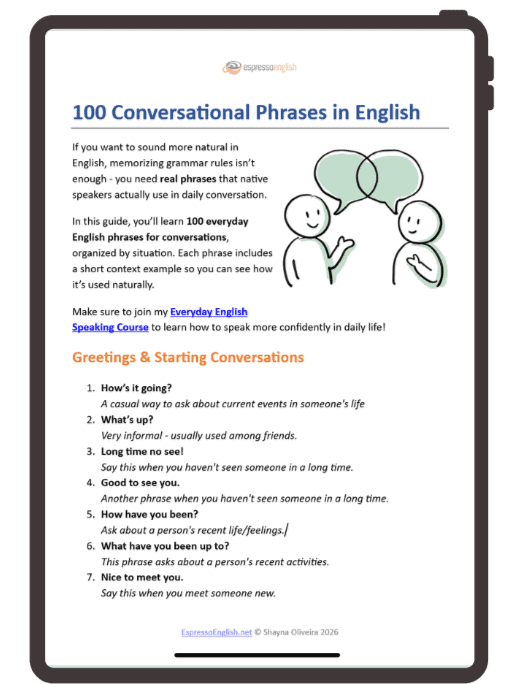
If you want to sound more natural in English, memorizing grammar rules isn’t enough – you need real phrases that native speakers actually use in daily conversation.
In this guide, you’ll learn 100 everyday English phrases for conversations, organized by situation, with a note about what they mean and when to use them.
Make sure to join my Everyday English Speaking Course to learn how to speak more confidently in daily life!
English Phrases For Greetings & Starting Conversations
-
How’s it going?
A casual way to ask about current events in someone’s life -
What’s up?
Very informal – usually used among friends. -
Long time no see!
Say this when you haven’t seen someone in a long time. -
Good to see you.
Another phrase when you haven’t seen someone in a long time. -
How have you been?
Ask about a person’s recent life/feelings. -
What have you been up to?
This phrase asks about a person’s recent activities. -
Nice to meet you.
Say this when you meet someone new. -
It’s been a while.
Say this when you haven’t seen the person for some time. -
How’s everything? / How are things?
General ways to ask about anything in a person’s life. -
How’s your family?
Ask about a person’s parents, kids, siblings, spouse.
English Phrases For Small Talk
-
Can you believe this weather?
Say this when the weather is surprising, intense, or unusual. -
Things have been crazy lately.
Say this if your life/work has been busy or chaotic recently. -
I can’t complain.
A reply to “How are you?” or “How are things?” – Say this if everything is good or normal. -
Same as usual.
A reply to “How are you?” or “How are things?” or “What have you been up to?” – Say this if there have been no major changes recently. -
That reminds me…
Say this when one topic of conversation reminds you of something else. -
Speaking of…
Say this when one topic of conversation reminds you of something else, ex. “Speaking of sports, did you watch the World Cup?” -
By the way…
Say this to introduce a new / separate topic -
Guess what?
Say this before telling a piece of good/surprising news. -
No way!
This expresses surprise. -
Really?
Say this to encourage the other person to keep talking / tell you more.
English Phrases For Making Plans
-
Are you free this weekend?
Asking if the other person is available. -
Do you want to grab coffee/lunch?
A casual way to invite someone. -
Let’s catch up soon.
This means you want to exchange news/updates. -
What works for you?
This is for asking which day/time is best for the other person to meet. -
Does that sound good?
Use this to check and confirm plans. -
Let me check my schedule.
Say this when you need to verify when you’re available. -
I’m in.
This means “I want to participate” -
I’m not sure yet.
Say this when you’re not ready to make a firm plan. -
Let’s play it by ear.
This means “let’s not make plans in advance – we’ll decide in the moment.” -
I’ll get back to you.
This means “I’ll give you an answer later.”
English Phrases For Agreeing & Disagreeing
-
I totally agree.
100% agreement. -
That makes sense.
This means you understand what the other person is saying, it is clear and logical. -
You’re right.
Saying the other person is correct. -
Exactly!
Saying the other person is 100% correct. -
I see what you mean.
Saying you understand their ideas/perspectives. -
I’m not so sure about that.
Expresses doubt/disagreement. -
I don’t think so.
Saying something is not true, in your opinion. -
That’s a good point.
Saying the other person has made a solid/convincing statement. -
Fair enough.
Also acknowledging the other person’s ideas are valid. -
I couldn’t agree more.
Expresses the strongest agreement.
English Phrases For Asking For Clarification
-
What do you mean?
Asking for more explanation. -
Could you explain that?
Asking for more detail. -
I didn’t catch that.
This means “I didn’t hear you clearly.” -
Can you say that again?
Asking the other person to repeat. -
What was that?
Asking the other person to repeat. -
Do you mind repeating that?
Asking the other person to repeat. -
Just to be clear… [summarize what they said]
Say this to verify you understood correctly. -
Are you saying that… [summarize what they said]?
Use this to check your understanding. -
Let me make sure I understand.
Use this to check your understanding. -
So what you’re saying is… [summarize what they said]
Use this to check your understanding.
English Phrases For Expressing Opinions
-
In my opinion…
In my opinion, it’s too expensive. -
I think…
I think we should leave early. -
I feel like…
I feel like something’s wrong. -
From my perspective…
From my perspective, it’s a good idea. -
If you ask me…
If you ask me, it’s worth it. -
Personally…
Personally, I prefer tea. -
It seems to me…
It seems to me that he’s upset. -
I’m pretty sure…
I’m pretty sure she’ll agree. -
I’d say…
I’d say we’re ready. -
That’s just my take.
This means “That’s just my view/opinion.”
English Phrases For Everyday Reactions
-
That’s awesome!
Say this to react to something great -
That’s too bad.
Say this to react to sad/disappointing news -
That’s surprising.
-
That’s interesting.
-
Good for you!
Say this to react to someone’s good action/accomplishment. -
That must be tough.
Say this to react to someone’s difficulty / hard time. -
I’m happy for you.
-
I’m sorry to hear that.
Say this to react to bad / sad news. -
That’s a relief.
Say this to react to good news after being worried. -
No kidding!
Say this when something is surprising or hard to believe.
English Phrases For Talking With Co-Workers
-
Let’s touch base tomorrow.
This means “Let’s contact each other / briefly discuss this tomorrow.” -
I’ll keep you posted.
This means “I’ll give you updates”
-
I think we’re on the same page.
This means “I think we agree / share similar views.” -
Let’s wrap this up.
This means “Let’s bring this [meeting/discussion/project] to an end.” -
I’ll look into it.
This means “I’ll investigate.” -
Let’s move forward.
This means “Let’s proceed.” -
Can we push this back?
This means “Can we delay this to a later date?” -
I’m running behind.
This means “My work is not up to date; it is late.” -
I’ll handle it.
This means “I will take action / solve the problem” -
That works for me.
Use this to agree to a plan.
English Phrases For Ending Conversations
-
I’ve got to run.
An informal way to say you need to leave. -
I should get going.
A polite, indirect way to say you need to leave. -
Let’s talk soon.
-
Catch you later.
An informal way to say “See you later” -
Take care.
A neutral way to say “goodbye” -
See you around.
Say this when you will probably encounter the other person again by chance. -
Have a good one.
Wishing the other person a good day. -
Talk to you soon.
-
Until next time.
-
It was great chatting.
Say this to thank the other person for the conversation.
Everyday Polite Phrases
-
Do you mind if…? / Would you mind…?
A polite way to ask if the other person will be bothered by your request/action. -
Would you like…?
A polite way to offer something to someone. - Could you please…?
A polite way to ask someone to do something. -
I’d appreciate it if…
Expressing gratitude in advance of your request. -
That would be great.
-
Thanks in advance.
-
No worries.
An informal way to reply to someone’s apology. -
My bad.
An informal way to say you made a minor mistake or did something wrong. -
I owe you one.
Say this after someone has done a favor / something nice for you. -
Much appreciated.
A nice way to say “thank you.”
🚀 Learn Everyday English Fast!
If you want to speak English more confidently in daily life, check out my Everyday English Speaking Courses: