
What are homographs in English?
Homographs are one of the reasons the English language can be so tricky! These are words that have the same spelling but different meanings—and sometimes they’re even pronounced differently.
In this lesson, you’ll learn 100 common homographs in English with their meanings and example sentences. As you read, pay attention to both the meaning and the pronunciation. Mastering these words will help you improve your vocabulary, avoid misunderstandings, and sound more natural when speaking English.
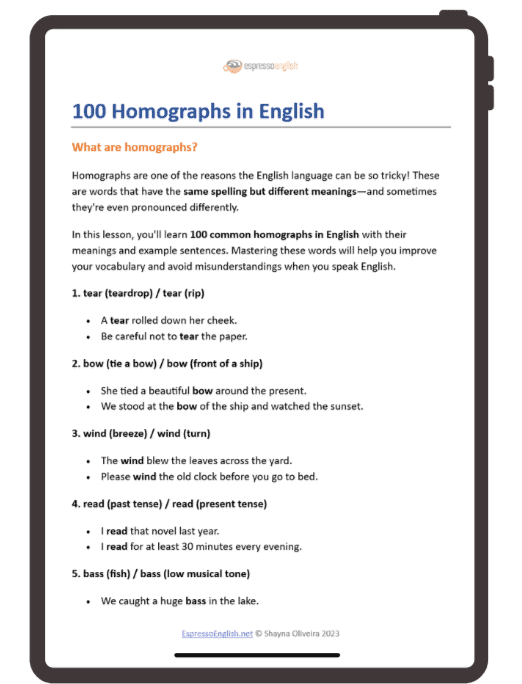
Download 100 homographs in English
100 homographs list
1. tear (teardrop) / tear (rip)
- A tear rolled down her cheek.
- Be careful not to tear the paper.
2. bow (tie a bow) / bow (front of a ship)
- She tied a beautiful bow around the present.
- We stood at the bow of the ship and watched the sunset.
3. wind (breeze) / wind (turn)
- The wind blew the leaves across the yard.
- Please wind the old clock before you go to bed.
4. read (past tense) / read (present tense)
- I read that novel last year.
- I read for at least 30 minutes every evening.
5. bass (fish) / bass (low musical tone)
- We caught a huge bass in the lake.
- She sings bass in the church choir.
6. close (shut) / close (nearby)
- Please close the window before you leave.
- We live close to the airport.
7. desert (arid land) / desert (abandon)
- They crossed the desert on foot.
- He would never desert his family.
8. lead (metal) / lead (guide)
- The old pipes contained lead.
- She will lead the meeting tomorrow.
9. live (verb) / live (adjective)
- I live in Chicago.
- The concert will be broadcast live.
10. row (line) / row (propel with oars)
- We sat in the front row at the theater.
- They row across the lake every morning.
11. object (thing) / object (disagree)
- Please don’t touch that object on the shelf.
- I object to your decision.
12. wound (injury) / wound (past tense of wind)
- The doctor cleaned the wound carefully.
- He wound the string around his finger.
13. minute (time) / minute (tiny)
- I’ll be ready in one minute.
- We noticed a minute crack in the glass.
14. refuse (garbage) / refuse (decline)
- The workers collected the refuse early this morning.
- She refused to answer the question.
15. record (document) / record (verb)
- The police checked his criminal record.
- Please record the meeting for those who can’t attend.
16. permit (allow) / permit (noun)
- Pets are permitted in this hotel.
- You need a permit to park here.
17. present (gift) / present (show)
- She gave me a birthday present.
- I’d like to present my idea to the team.
18. invalid (not valid) / invalid (sick person)
- Your password is invalid.
- The invalid needed help getting out of bed.
19. conduct (behavior) / conduct (lead)
- His conduct at work was professional.
- She will conduct the orchestra tonight.
20. project (noun) / project (verb)
- Our science project is due on Friday.
- The speaker tried to project her voice across the room.
21. produce (verb) / produce (noun)
- This factory produces thousands of cars every year.
- We buy fresh produce at the farmers’ market.
22. content (satisfied) / content (subject matter)
- She felt content after spending the day with her family.
- The content of the course is very practical.
23. perfect (excellent) / perfect (make complete)
- Your pronunciation is perfect.
- She worked hard to perfect her technique.
24. contest (competition) / contest (verb)
- She won the singing contest.
- The company plans to contest the fine in court.
25. suspect (person of interest) / suspect (verb)
- The police questioned the main suspect.
- I suspect he’ll arrive late.
26. impact (noun) / impact (verb)
- The new law had a positive impact on small businesses.
- Rising prices will impact many families.
27. excuse (pardon) / excuse (verb)
- That’s a poor excuse for being late.
- Please excuse me for interrupting.
28. rebel (noun) / rebel (verb)
- The rebel refused to obey the king.
- Some teenagers rebel against their parents’ rules.
29. sow (female pig) / sow (plant seeds)
- The sow stayed close to her piglets.
- Farmers sow corn in the spring.
30. subject (topic) / subject (verb)
- Math was my favorite subject in school.
- No one should be subjected to unfair treatment.
31. defect (flaw) / defect (leave one group for another)
- The car was recalled because of a manufacturing defect.
- Two soldiers defected to the other side during the war.
32. separate (distinct) / separate (divide)
- We stayed in separate rooms at the hotel.
- Please separate the white clothes from the colored ones.
33. address (location) / address (verb)
- Please write your address on the form.
- The manager will address the problem tomorrow.
34. bat (animal) / bat (baseball equipment)
- A bat flew out of the cave at sunset.
- He hit the ball with a wooden bat.
35. incense (fragrant substance) / incense (verb)
- They burned incense during the ceremony.
- His rude comments incensed everyone in the room.
36. content (pleased) / content (verb)
- The children looked content after playing outside.
- She tried to content herself with what she had.
37. protest (demonstration) / protest (object)
- Thousands of people joined the protest downtown.
- The workers plan to protest the new policy.
38. import (goods brought into a country) / import (bring into a country)
export (goods sold to another country) / export (sell to another country)
- Coffee is one of the country’s biggest imports.
- The company imports fruit from South America.
- Rice is one of the country’s main exports.
- This company exports electronics to Europe.
39. object (verb) / object (thing)
- I object to raising taxes.
- A strange object floated across the sky.
40. decrease (verb) / decrease (noun)
- We need to decrease our expenses this month.
- There was a significant decrease in sales last quarter.
41. entrance (entry) / entrance (fascinate)
- Please wait for me at the main entrance.
- The magician’s performance will entrance the audience.
42. digest (summary) / digest (process food)
- I read a news digest every morning.
- It takes several hours to digest a large meal.
43. alternate (every other) / alternate (take turns)
- We meet on alternate Fridays.
- They alternate between working from home and going to the office.
44. project (verb) / project (noun)
- You need to project your voice so everyone can hear you.
- Our class is working on a history project.
45. contract (agreement) / contract (become smaller)
- We signed the contract yesterday.
- Metal contracts when it gets cold.
46. attribute (quality) / attribute (credit)
- Patience is an important attribute for a teacher.
- Many people attribute her success to hard work.
47. compact (small) / compact (compress)
- We bought a compact car for city driving.
- The machine compacts the trash into small blocks.
48. exploit (take advantage of unfairly) / exploit (notable achievement)
- Some companies exploit cheap labor.
- Landing on the moon was an incredible exploit.
49. duplicate (copy) / duplicate (make a copy)
- I accidentally printed a duplicate of the report.
- Can you duplicate this key for me?
50. console (control panel) / console (comfort)
- The game console is connected to the TV.
- She tried to console her friend after the bad news.
Download 100 homographs in English
Now you know 100 homographs in English!
Now that you’ve learned 100 common English homographs, the next step is to start noticing them when you read and listen to English. The more you notice them, the easier it becomes to recognize which meaning—and pronunciation—is correct from the context.
Also check out 100 homophones in English – words that sound the same, but with different spellings and meanings.
If you’d like to expand your vocabulary even further, check out my Vocabulary Builder Courses, where you’ll learn thousands of useful words, expressions, collocations, and phrasal verbs organized by topic.
And if you’d like to improve your pronunciation and speak English more clearly and confidently, my American English Pronunciation Course will help you master difficult sounds, word stress, rhythm, and connected speech with practical lessons and exercises.