Have you ever been in the middle of an English conversation and suddenly you don’t know what to say?
Maybe someone asks you a question and you need a few seconds to think. Maybe you don’t understand what the other person said. Or maybe the conversation reaches an awkward silence.
The good news is that you don’t need to have the perfect response ready at every moment. Native English speakers experience these situations, too – and we have lots of expressions that help us handle them naturally.
Today I’ll teach you 30 practical English conversation phrases for those moments when you don’t know what to say. These are great expressions to have ready in your mind so that you don’t freeze up when speaking English.
You can join my Everyday English Speaking Courses to learn what native speakers say in lots of different situations in daily life!
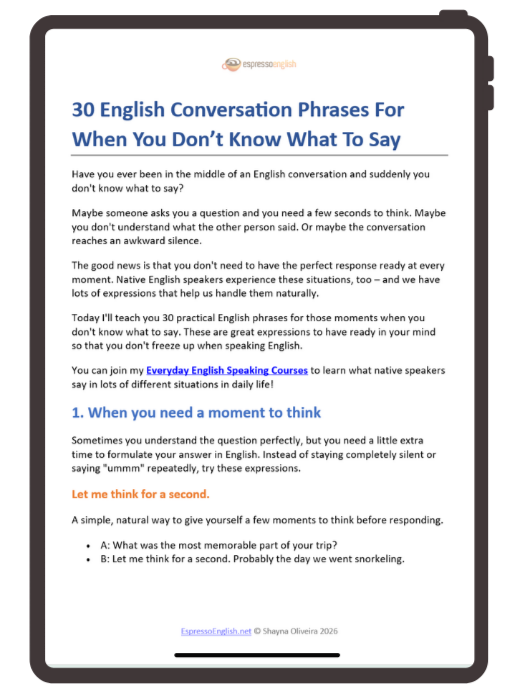
1. When you need a moment to think
Sometimes you understand the question perfectly, but you need a little extra time to formulate your answer in English. Instead of staying completely silent or saying “ummm” repeatedly, try these English conversation phrases.
Let me think for a second.
A simple, natural way to give yourself a few moments to think before responding.
- A: What was the most memorable part of your trip?
- B: Let me think for a second. Probably the day we went snorkeling.
That’s a good question.
You can use this expression to acknowledge someone’s question while giving yourself a little time to consider your answer.
- A: If you could change one thing about your job, what would it be?
- B: That’s a good question. I guess I’d like to have more flexibility.
How should I put this?
Use this when you know what you want to communicate, but you’re trying to find the right words to express it, especially if the topic is complicated or sensitive.
- A: Did you enjoy working with your previous manager?
- B: How should I put this? He was very talented, but he wasn’t particularly good at managing people.
Let me gather my thoughts.
This means you need a moment to organize your ideas before speaking.
- A: What did you think of the presentation?
- B: Let me gather my thoughts. There were some excellent ideas, but I have a few concerns as well.
Nothing comes to mind right now.
Use this when you can’t immediately think of an answer, example, or suggestion.
- A: Can you recommend any good restaurants around here?
- B: Nothing comes to mind right now, but I’ll let you know if I think of one.
I’m trying to find the right words.
This is especially useful for English learners because it lets the other person know that you’re still thinking about how to express yourself.
- A: How did you feel when you finally achieved your goal?
- B: I’m trying to find the right words. It was a mixture of excitement, relief, and disbelief.
2. When you don’t understand something
Don’t pretend to understand something when you don’t! Asking for clarification is a completely normal part of English conversation, even among native speakers.
Sorry, I didn’t catch that.
Use this when you didn’t hear or understand what someone just said, perhaps because they spoke quickly or there was background noise.
- A: We’ll meet at the entrance on the north side of the building.
- B: Sorry, I didn’t catch that. Where are we meeting?
Could you run that by me again?
This is a conversational way to ask someone to repeat or explain something again.
- A: You’ll need to transfer the files before you update the software.
- B: Could you run that by me again?
I’m not quite following you.
Use this when you can hear the words someone is saying, but you’re having trouble understanding their explanation or train of thought.
- A: So technically, we’d save money by spending more money upfront.
- B: I’m not quite following you. How would that work?
What exactly do you mean by that?
Use this when someone’s statement is unclear, vague, or open to different interpretations.
- A: I think we need to take a different approach.
- B: What exactly do you mean by that?
Be aware that your tone of voice is important here. A curious, friendly tone makes this sound like a genuine request for clarification.
Could you give me an example?
Sometimes the easiest way to understand an unfamiliar concept is to ask for a specific example.
- A: You need to make your writing more engaging.
- B: Could you give me an example?
So, are you saying that…?
This is a great way to check your understanding by expressing the other person’s idea in your own words.
- A: We won’t be able to start until everyone has submitted their documents.
- B: So, are you saying that one missing document could delay the entire process?
This technique is particularly useful because it gives the other person an opportunity to confirm or correct your understanding.
3. When you can’t think of a word in English
You might know exactly what you want to say, but there’s one specific English word you can’t remember. Here are some English conversation phrases to handle that situation without abandoning your sentence.
What’s the word I’m looking for?
You can say this out loud when you’re searching for a particular word.
- The instructions were really… what’s the word I’m looking for?… misleading! That’s it.
It’s on the tip of my tongue.
This idiom means you feel that you’re very close to remembering a word, name, or piece of information, but you can’t quite remember it.
- A: Who’s the actor who played the main character?
- B: Oh, I know his name! It’s on the tip of my tongue.
I can’t think of the word, but it’s…
Instead of stopping completely, try describing the thing you’re talking about.
- I can’t think of the word, but it’s a tool you use to remove the skin from vegetables.
The word in this case is “peeler.”
This is an excellent strategy for English learners. You can often communicate successfully even when you don’t know the exact vocabulary word.
For lack of a better word…
Use this expression when you’re choosing a word that isn’t quite perfect, but it’s the closest one you can think of.
- The atmosphere at the party was, for lack of a better word, strange.
Let me rephrase that.
Use this when you’ve said something that didn’t come out quite right, and you want to express the same idea differently.
- I don’t care about the project… let me rephrase that. I care about the project, but I don’t think we should rush to finish it.
What I’m trying to say is…
This expression helps you get back to your main point if your explanation has become confusing or you’ve gotten a little lost while speaking.
- What I’m trying to say is that we can disagree with each other and still be good friends.
Remember, you don’t need to speak English perfectly on your first attempt. You can correct yourself, start a sentence again, or explain something in a different way.
4. When you’re caught off guard or in an awkward situation
Sometimes the difficulty isn’t your English at all. Someone might tell you something unexpected, ask you an uncomfortable question, or share some difficult news. Even native English speakers can struggle to find the right response in these situations.
I wasn’t expecting that!
A natural reaction when someone tells you something surprising.
- A: I’ve decided to sell my house and travel around the world for a year.
- B: Wow, I wasn’t expecting that!
I don’t know what to say.
Sometimes this is exactly the right thing to say! You can use it when you’re shocked, deeply touched, or overwhelmed by emotion.
- A: We all chipped in to buy you something special for your birthday.
- B: Oh, I don’t know what to say! Thank you so much.
I’m at a loss for words.
This idiomatic expression means you’re so surprised, upset, or emotionally affected by something that you can’t find the words to respond.
- A: Someone anonymously donated enough money to cover all our expenses.
- B: That’s incredible. I’m at a loss for words.
I can’t imagine what you’re going through.
This is a compassionate response when someone tells you about a particularly difficult experience.
- A: It’s been really hard taking care of my father since he became seriously ill.
- B: I can’t imagine what you’re going through. How are you holding up?
You don’t always need to offer advice or try to solve someone’s problem. Sometimes simply acknowledging their feelings is enough.
I’d rather not get into that.
Use this when someone brings up a personal or uncomfortable topic that you don’t want to discuss.
- A: What exactly happened between you and your ex?
- B: I’d rather not get into that.
The expression “get into something” in this context means to discuss it in detail.
Well, this is awkward.
This is an informal, sometimes humorous way to acknowledge an uncomfortable situation.
- A: Oh no, I just realized I’ve been calling you by the wrong name all evening.
- B: Well, this is awkward!
Sometimes acknowledging the awkwardness with a little humor can actually make the situation less uncomfortable.
5. When you want to keep the conversation going
One of the biggest secrets to being a good conversationalist is that you don’t always need to have something interesting to say yourself. You can encourage the other person to continue talking, ask follow-up questions, or introduce a new topic, by using one of these English conversation phrases:
How so?
This short expression means “In what way?” or “How is that the case?”
- A: Living abroad completely changed my perspective on life.
- B: How so?
It’s a great way to encourage someone to explain their statement in more detail.
What was that like?
Use this to ask someone about their experience of doing something or being in a particular situation.
- A: I spent six months volunteering in a remote village.
- B: What was that like?
This is an open-ended question that encourages the other person to share more than just a yes or no answer.
How’s that going so far?
Use this question when someone mentions something new or ongoing in their life, such as a project, a job, a hobby, or a change in their lifestyle. It shows interest and encourages them to share their experiences.
- A: I’ve started taking an online photography course.
- B: Oh, nice! How’s that going so far?
- A: Pretty well! I’ve already learned a lot about lighting and composition.
If someone tells you about something they’ve been doing for a longer period of time, you can simply ask, “How’s that going?”
And then what happened?
This is a simple but effective way to show interest when someone is telling you a story.
- A: When we arrived at the hotel, they told us they couldn’t find our reservation.
- B: Oh no! And then what happened?
You don’t need to interrupt the story with your own experience. Sometimes the best response is simply to encourage the other person to continue.
That reminds me…
Use this expression to introduce a related story, experience, or topic.
- A: We took our kids camping for the first time last weekend.
- B: That reminds me of a funny experience I had on a camping trip when I was younger.
You can also use “That reminds me” to bring up something you suddenly remembered.
On a different note…
What if the conversation has reached a natural stopping point and you want to introduce a completely different topic?
You can use the expression “On a different note” to make that transition less abrupt.
-
- A: Well, I’m glad everything worked out in the end.
- B: Me too! On a different note, have you made any plans for the holidays?
Practice Quiz: English Conversation Phrases
Now that you’ve learned these English conversation phrases, choose the best expression for each situation.
1. Someone asks you a difficult question, and you need a moment to organize your ideas.
a) Nothing comes to mind right now.
b) Let me gather my thoughts.
c) I’m at a loss for words.
2. You heard someone’s explanation, but you don’t understand their reasoning.
a) I wasn’t expecting that.
b) Let me rephrase that.
c) I’m not quite following you.
3. You know a particular word, and you feel very close to remembering it.
a) It’s on the tip of my tongue.
b) I’d rather not get into that.
c) How’s that going so far?
4. You’ve chosen a word that isn’t exactly what you mean, but you can’t think of a more suitable one.
a) On a different note…
b) For lack of a better word…
c) That reminds me…
5. Someone asks you a personal question that you don’t feel comfortable answering.
a) Could you run that by me again?
b) What I’m trying to say is…
c) I’d rather not get into that.
6. You want to check whether you’ve correctly understood someone’s explanation.
a) So, are you saying that…?
b) What was that like?
c) And then what happened?
7. You’ve expressed an idea badly and want to say it in a different way.
a) Let me think for a second.
b) Let me rephrase that.
c) Could you give me an example?
8. A friend tells you she’s recently started training for a marathon. You want to ask about her progress.
a) How should I put this?
b) What exactly do you mean by that?
c) How’s that going so far?
9. A friend has just told you about an extremely difficult personal experience. You want to express sympathy.
a) I can’t imagine what you’re going through.
b) Well, this is awkward.
c) That’s a good question.
10. You want to smoothly introduce an unrelated topic into the conversation.
a) For lack of a better word…
b) On a different note…
c) What exactly do you mean by that?
Quiz Answers
- b) Let me gather my thoughts.
- c) I’m not quite following you.
- a) It’s on the tip of my tongue.
- b) For lack of a better word…
- c) I’d rather not get into that.
- a) So, are you saying that…?
- b) Let me rephrase that.
- c) How’s that going so far?
- a) I can’t imagine what you’re going through.
- b) On a different note…
Learn more: 100 English phrases for conversations
Speak more confidently in English conversations
Here’s what I’d like you to do: choose one or two of the English conversation phrases from each category in today’s lesson and practice saying them out loud several times.
You want these expressions to become automatic, so that the next time you’re in a conversation and your mind goes blank, you have something ready to say.
Being a confident English speaker doesn’t mean you always know exactly what to say. It means you know how to handle the moments when you don’t.
And if you’d like to learn more practical phrases for everyday English conversations, check out my Everyday English Speaking Courses.
You’ll learn what to say in dozens of real-life situations, how to express yourself more naturally, and how to participate in conversations with greater confidence – instead of constantly wondering what to say next.