Have you ever heard native speakers say things like “You’re coming, aren’t you?” or “It’s cold today, isn’t it?”
These short phrases at the end of a sentence are called question tags — and they’re extremely common in everyday English conversation.
They’re used to confirm information, show interest, or invite agreement. Let’s learn how they work, and see 50 examples of tag questions.
What Is a Question Tag?
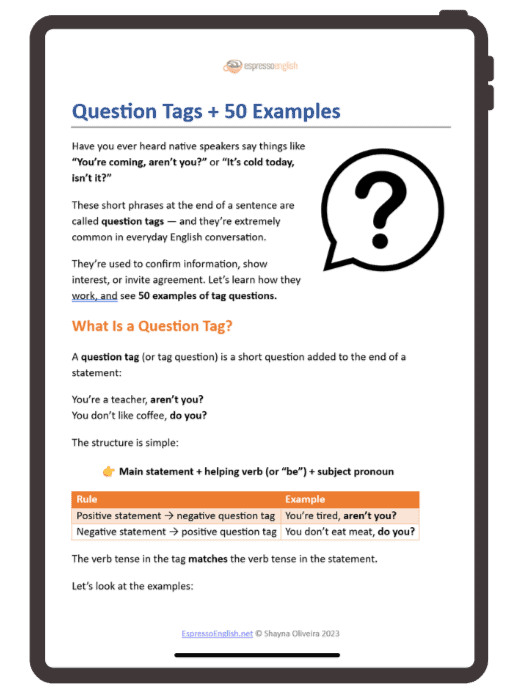
A question tag (or tag question) is a short question added to the end of a statement:
You’re a teacher, aren’t you?
You don’t like coffee, do you?
The structure is simple:
👉 Main statement + helping verb (or “be”) + subject pronoun
| Rule | Example |
|---|---|
| Positive statement → negative question tag | You’re tired, aren’t you? |
| Negative statement → positive question tag | You don’t eat meat, do you? |
The verb tense in the tag matches the verb tense in the statement.
Question Tags with the Verb “Be”
| Statement | Tag Question | Example Response |
| It’s cold today, | isn’t it? | Yes, it’s freezing! |
| She’s from Brazil, | isn’t she? | That’s right. |
| You’re hungry, | aren’t you? | A little bit, yes. |
| We’re late, | aren’t we? | No, we’re on time. |
| He’s at work, | isn’t he? | Yes, he is. |
| They’re married, | aren’t they? | Yes, for five years. |
| It isn’t ready, | is it? | No, not yet. |
| You aren’t busy, | are you? | No, I can help. |
| She isn’t coming, | is she? | I don’t think so. |
| This isn’t your first time here, | is it? | No, I’ve been here before. |
| That movie was amazing, | wasn’t it? | Yeah! I loved it! |
| He wasn’t interested, | was he? | No, he wasn’t. |
| These shoes were expensive, | weren’t they? | Actually, I got them on sale. |
| The tires weren’t replaced, | were they? | No, there was no need. |
Question Tags with “Do / Does / Did”
| Statement | Tag Question | Example Response |
|---|---|---|
| You like coffee, | don’t you? | Yes, I love it. |
| He plays tennis, | doesn’t he? | Yes, every weekend. |
| They work hard, | don’t they? | Definitely. |
| She doesn’t eat meat, | does she? | No, she’s vegetarian. |
| You don’t live nearby, | do you? | No, I live outside the city. |
| They didn’t call you, | did they? | No, not yet. |
| You did your homework, | didn’t you? | Of course! |
| He didn’t finish the report, | did he? | No, he’s still working on it. |
| You like spicy food, | don’t you? | Yes, very much. |
| They understand the problem, | don’t they? | I think so. |
Question Tags with “Have / Has / Had”
| Statement | Tag Question | Example Response |
| You’ve met her before, | haven’t you? | Yes, at last year’s party. |
| She’s finished her work, | hasn’t she? | Yes, she just emailed it. |
| They’ve already left, | haven’t they? | Yes, about 10 minutes ago. |
| We’ve been here before, | haven’t we? | Yeah, this place looks familiar. |
| You haven’t seen my keys, | have you? | No, sorry. |
| He hasn’t called yet, | has he? | No, maybe later. |
| I’ve made a mistake, | haven’t I? | Yes, this is incorrect. |
| They haven’t started the meeting, | have they? | No, they’re waiting for everyone. |
| They hadn’t met before, | had they? | No, that was their first meeting. |
| You’d already heard the news, | hadn’t you? | Yes, I’d seen it on TV. |
Question Tags with “Will / Would / Can / Could / Should / Must”
| Statement | Tag Question | Example Response |
|---|---|---|
| You’ll help me, | won’t you? | Sure, no problem. |
| She’ll call later, | won’t she? | Yes, she promised. |
| You’d like some coffee, | wouldn’t you? | Yes, please. |
| He’d rather stay home, | wouldn’t he? | Probably. |
| You can drive, | can’t you? | Yes, I can. |
| They can’t swim, | can they? | No, they can’t. |
| We could meet tomorrow, | couldn’t we? | That works. |
| You should study more, | shouldn’t you? | Yeah, you’re right. |
| He must be tired, | mustn’t he? | Yes, he worked all night. |
| Let’s go for a walk, | shall we? | Great idea! |
💬 When and Why We Use Question Tags
| Function | Example | Meaning |
|---|---|---|
| Check information | You sent the email, didn’t you? | Confirming. |
| Show interest / empathy | You’re tired, aren’t you? | Showing concern. |
| Invite agreement | It’s a beautiful day, isn’t it? | Friendly connection. |
| Keep the conversation going | You like movies, don’t you? | Encouraging response. |
🧠 Quick Tips to Remember About Question Tags
-
If the statement is positive → use a negative tag.
You’re free, aren’t you? -
If the statement is negative → use a positive tag.
You don’t like rain, do you? -
Use contractions to sound natural (isn’t, don’t, can’t, won’t).
-
Match the tense of the question tag to the verb tense in the main statement.
-
Use intonation:
-
Rising tone (↗) → real question (“You like pizza, don’t you?”)
-
Falling tone (↘) → statement seeking agreement (“Nice weather, isn’t it?”)
-
☕ Practice Time
Try writing ten tag questions using the different formats you saw in the examples above.
📘 Learn English Grammar & Speaking
You’ll find 70+ lessons + quizzes teaching you essential English grammar in my Basic & Intermediate Grammar E-Books
If you want to speak English more confidently in daily life, check out my Everyday English Speaking Courses!