
American English pronunciation course
Did you know that there’s one small letter that completely changes how a word is pronounced in English?
It’s called the “silent E” and today we’ll learn how it changes the sound of all five vowels – a, e, i, o, and u. Understanding this is essential for pronouncing words correctly in English.
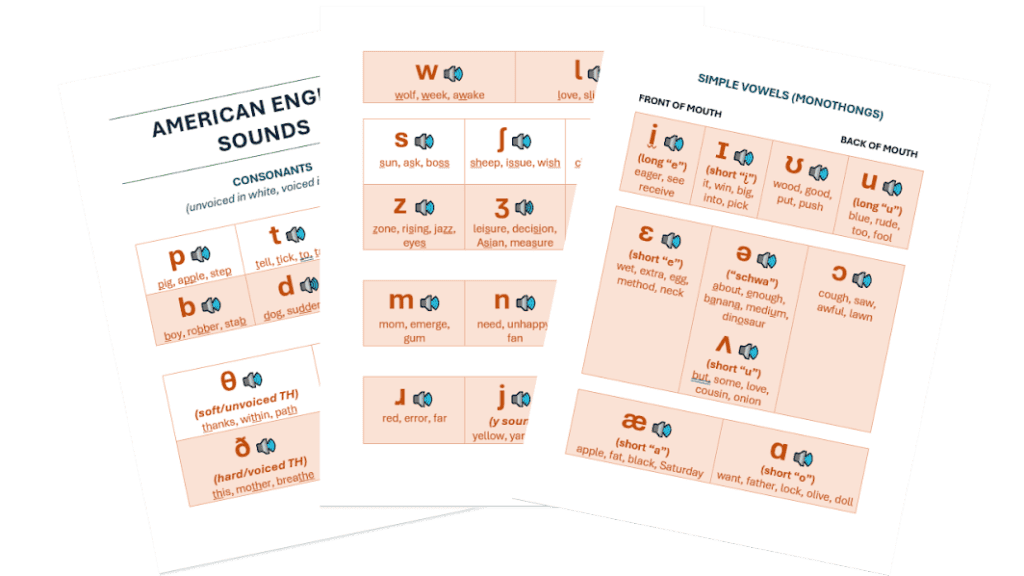
Speaking of pronunciation, I have a great resource to help you – it’s my Pronunciation Guide to the sounds of American English. You can download it for free!
How the “silent E” in English changes the vowel
When a word ends in a consonant + E, then the “E” is silent… but it makes the vowel before it “say its name.” In other words, it changes the vowel from a short one to a long one. You’ll hear it better with examples.
🅰️ Short A → Long A
Repeat after me:
- mat → mate
- cap → cape
- hat → hate
- mad → made
- tap → tape
Other words that end in long a + consonant + silent E include late, name, cage, safe, and place.
🅸 Short I → Long I
Repeat after me:
- bit → bite
- rid → ride
- kit → kite
- win → wine
- dim → dime
Other words that end in long i + consonant + silent E include time, line, side, drive, and smile.
🅾️ Short O → Long O
Repeat after me:
- hop → hope
- not → note
- cod → code
- rod → rode
- pop → pope
Other words that end in long o + consonant + silent E include home, close, stone, hope, and globe
🅴 Short E → Long E
This is actually not a common pattern, so I couldn’t find many words, but we do have:
- pet → Pete
- met → mete
- them → theme
🅤 Short U → Long U
Repeat after me:
- tub → tube
- dud → dude
- glut → glute
Other words that end in long u + consonant + silent E include rude, consume, tune, fluke, rule
Interestingly, we also have words where the vowel sound becomes “you” instead of just “oo”
- cut → cute (not coot)
- cub → cube
- hug → huge
We also have excuse, dispute, refuse, confuse, and compute.
Important Note About the Silent “E”
This rule works MOST of the time — but English has exceptions.
In these words, the E is silent — but the vowel doesn’t say its name:
- have
- come
- love
- done
Still, this pattern is one of the most powerful rules in English, and it helps improve your pronunciation and spelling.
Having nice clear pronunciation is essential if you want other people to understand your English without saying “huh?” And I can help you improve it in the next 30 days when you join my American English Pronunciation Course.
We’ll go through the language sound by sound, helping you practice hearing and pronouncing the small differences between them. At the end of the course, our teaching team will evaluate your pronunciation and give you personalized feedback!