
Everyday English Speaking Courses
Do you often say “I don’t know” in English? Let’s learn some better phrases!
Native speakers use lots of different expressions depending on the situation – so today I’ll teach you 15 natural ways to say “I don’t know” – from more casual to more professional.
If you want an instant upgrade to your speaking, make sure to download my free e-book with 500 real English phrases. It also comes with audio so you can hear them and train your pronunciation.
Conversational ways to say “I don’t know”
Instead of “I don’t know,” you could say:
- “I’m not sure. / I’m not certain.”
A little softer and more polite
👉 “What time is the next bus?”
“I’m not sure, but they usually come about every 10 minutes.” - “I have no idea.”
Stronger — you completely don’t know
👉 “I have no idea where she went – she didn’t tell me anything.” - “I have no clue.”
Another strong and informal phrase.
👉 “I have no clue where my sunglasses are; I’ve been looking for them all day.” - “Beats me.”
This one is also very informal and conversational
👉 “Why is the road closed?”
“Beats me.” - “Who knows?”
Used when nobody really knows!
👉 “Is it going to rain this weekend?”
“Who knows?” - “Your guess is as good as mine.”
Funny, conversational expression.
👉 “What time will he be home from the party?”
“Your guess is as good as mine.” - “I haven’t got the faintest idea.”
Emphasizes total confusion
👉 “I haven’t got the faintest idea how this machine works.” - “I couldn’t tell you.”
This doesn’t mean you’re not allowed to tell, it means you simply don’t know, you don’t have the information, and that’s why you couldn’t tell the other person.
👉 “Were there a lot of people at the concert?”
“I couldn’t tell you — I wasn’t there.”
More formal ways to say “I don’t know”
When it comes to saying “I don’t know” in a business or professional situation, we often use a phrase that implies we will try to find the information or discover the answer. For example:
- “That’s a good question.”
We use this to “buy time” – get a little time before answering. You can say “That’s a good question” and think for a moment about your answer, then give an answer, or you can say “That’s a good question” and then continue with a phrase like “I’m not sure.” - Let me check on that / Let me double-check.
Means you are going to find the information or confirm the information. - I’ll need to look into it.
This implies that further investigation is needed, and it might take more time than a quick check. - I don’t have the details in front of me.
When you have the information but it’s not immediately available. - I’m not the best person to answer that.
When you want to redirect the question to another person who knows more. You can add, “…but Sarah would know.” - I don’t have a definitive answer yet.
Say this when the answer is still in the process of being resolved or worked on, so you can’t say it with certainty yet. - I’ll have to get back to you on that.
Simply means you will give the person an answer later.
There you go! Now you know lots of ways to say “I don’t know” in English – so you can sound natural and competent, even when you can’t answer a question.
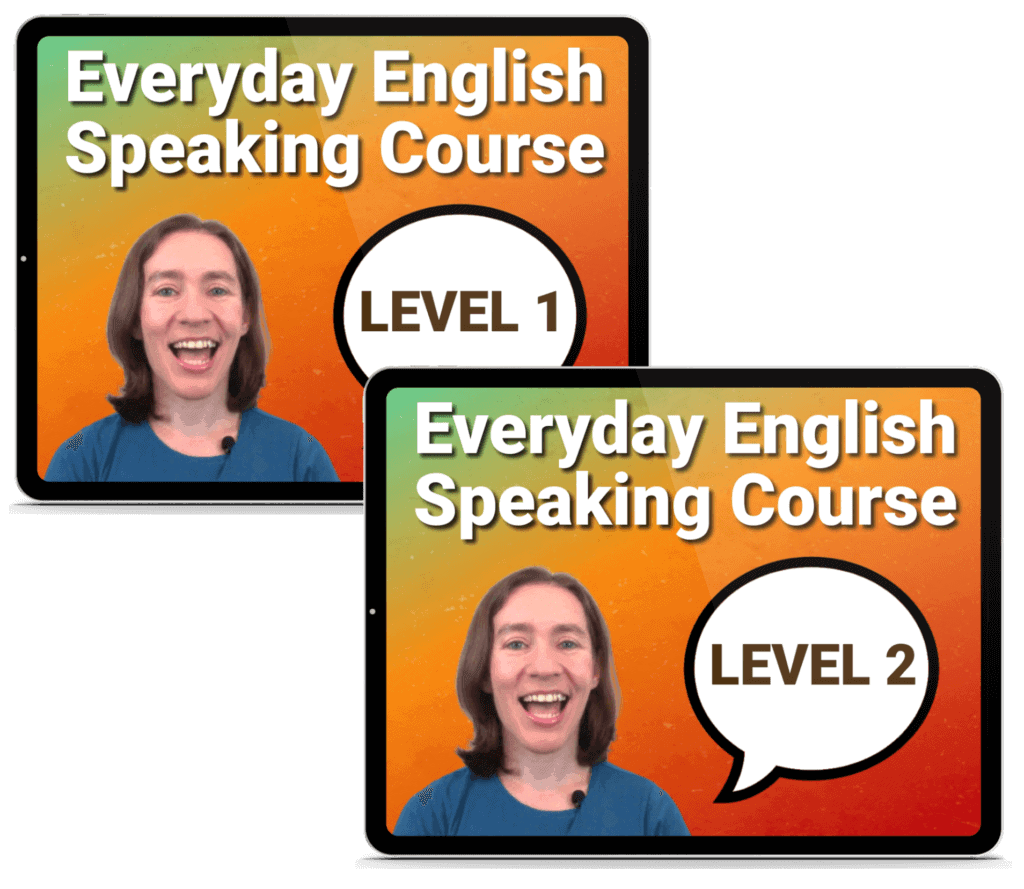
You can learn lots more real phrases used by native English speakers inside my Everyday English Speaking Courses.
Level 1 of the course teaches you practical phrases for daily life, and Level 2 teaches you more advanced expressions.