

Let’s learn phrasal verbs for the things you do every day!
We’ll go through a typical daily routine, learning 30 essential phrasal verbs along the way. These are some of the most common phrasal verbs in English because we use them for these simple daily actions.
Before we get started, let me remind you to download the free lesson PDF to help you remember and review these common phrasal verbs.
Now, let’s go through the day step by step, starting with our morning routine.
🌅 MORNING ROUTINE
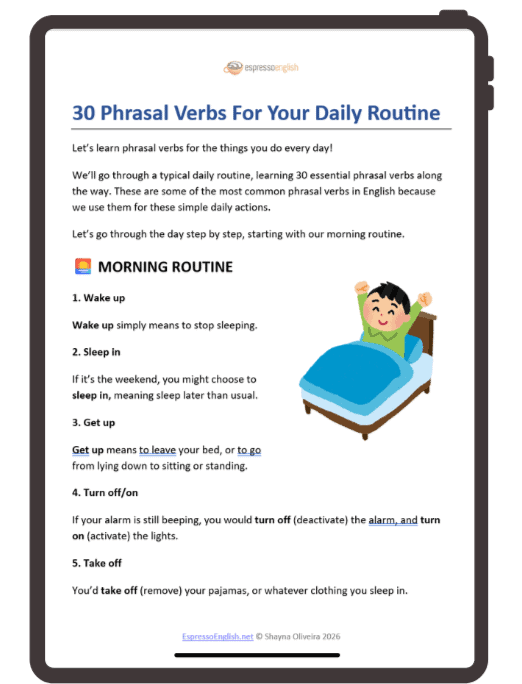
1. Wake up
Wake up simply means to stop sleeping.
2. Sleep in
If it’s the weekend, you might choose to sleep in, meaning sleep later than usual.
3. Get up
Get up means to leave your bed, or to go from lying down to sitting or standing.
4. Turn off/on
If your alarm is still beeping, you would turn off (deactivate) the alarm, and turn on (activate) the lights.
5. Take off
You’d take off (remove) your pajamas, or whatever clothing you sleep in.
6. Pick out
Then, pick out your clothes for the day, meaning to choose/select them.
7. Put on
And put on your clothes, start to wear them.
🏠 GETTING READY / LEAVING
8. Chop up
If you want a healthy breakfast, you could chop up some vegetables (meaning cut them into small pieces) and add them to your eggs.
9. Head out
After breakfast, you’d head out – meaning to leave home.
10. Get on (a bus/train) or get into (your car)
All these phrasal verbs mean to enter the vehicle.
11. Drop off
Maybe you’ll need to drop off your kids at school, meaning take them to school and leave them there.
💼 WORK / STUDY
12. Log in
At work, you might need to log in to your computer or e-mail (meaning enter with a password).
13. Look through/over
You’d look through/over your tasks for the day, meaning briefly review them.
14. Figure out
After seeing your tasks, you’d figure out (understand or solve) which one to do first.
15. Work on
You’d work on the most important or urgent task – meaning to spend time doing it.
16. Deal with
You might need to deal with some problems or challenges – take action to handle them.
17. Keep up with
Hopefully you can keep up with your work, meaning make progress at an appropriate speed.
18. Catch up on
If you get delayed, you’ll need to catch up on work over the weekend – meaning to do something you didn’t have time for before
19. Meet with
You might meet with your manager (encounter, spend time with)
20. Go over
You and your manager can go over – meaning review – plans for an event next month.
☕ FREE TIME
21. Work out
After work, you might go to the gym to work out – meaning exercise.
22. Hang out
Or if you’re feeling more social, you could hang out with your friends, meaning spend time together casually.
23. Pick up
Don’t forget to pick up your kids – meaning get them from a place.
🌆 EVENING ROUTINE
24. hang up
When you come into your house, you’d hang up your jacket or coat – put it on a hook or hanger.
25. heat up
You could heat up some leftovers for dinner, meaning to make the food hot again in the oven, microwave, or on the stove.
26. tidy up / clean up
If the house is messy, you’ll need to tidy up or clean up, meaning organize it.
27. put away
The kids can help put away their toys, putting them in the proper place.
28. wind down
Now the day is winding down, meaning coming to an end, and activity is becoming slower.
29. talk over
You might talk over (discuss) plans for the weekend with your husband or wife.
30. turn in
Finally, it’s time to turn in – this is another way to say “go to bed.”
Use the Daily Routine Phrasal Verbs Yourself!
Now you know how to describe your daily routine using phrasal verbs!
Can you use some of them in your own sentences?
Learn Phrasal Verbs Easily and Naturally
Learning phrasal verbs in context makes them much easier to remember. That’s why I teach a course called Phrasal Verbs in Conversation.
Inside it, you WON’T get lists of phrasal verbs to memorize. Instead, you’ll see how they are really used in conversations, so you can learn them easily and naturally.
Phrasal Verbs in Conversation is one of our most popular courses!