
Download 50 formal-informal phrases
Everyday English Speaking Course
When to Use Formal vs. Informal English
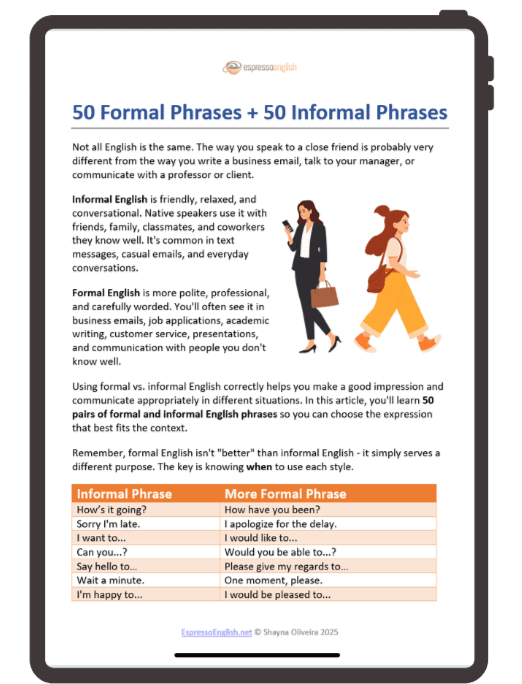
Not all English is the same. The way you speak to a close friend is probably very different from the way you write a business email, talk to your manager, or communicate with a professor or client.
Informal English is friendly, relaxed, and conversational. Native speakers use it with friends, family, classmates, and coworkers they know well. It’s common in text messages, casual emails, and everyday conversations.
Formal English is more polite, professional, and carefully worded. You’ll often see it in business emails, job applications, academic writing, customer service, presentations, and communication with people you don’t know well.
Using formal vs. informal English correctly helps you make a good impression and communicate appropriately in different situations. In this article, you’ll learn 50 pairs of formal and informal English phrases so you can choose the expression that best fits the context.
Remember, formal English isn’t “better” than informal English – it simply serves a different purpose. The key is knowing when to use each style.
| Informal Phrase | More Formal Phrase |
| How’s it going? | How have you been? |
| Sorry I’m late. | I apologize for the delay. |
| I want to… | I would like to… |
| Can you…? | Would you be able to…? |
| Say hello to… | Please give my regards to… |
| Wait a minute. | One moment, please. |
| I’m happy to… | I would be pleased to… |
| I’m not sure. / I don’t know. | I’m not certain. |
| I don’t think so. | I don’t believe that is the case. |
| That’s not OK. | That is not acceptable. |
| I’ll check. | I will look into the matter. |
| I’ll think about it. | I will give it some consideration. |
| We need to… | It is necessary to… |
| We should… | It would be advisable to… |
| I found out what was wrong. | I discovered the problem/issue. |
| If you need help… | Should you require assistance… |
| As we talked about… | As previously discussed… |
| Before… | Prior to… |
| About… | With regard to… |
| I can’t wait to… | I look forward to… |
| Please write back soon. | Please reply at your earliest convenience. |
| We finished it. | The project has been completed. |
| Tell me if… | Please advise if… |
| Don’t forget… | I would like to remind you… |
| I can’t go. | I am unable to attend. |
| We’ll make sure that… | We will ensure that… |
| Do you want to…? | Would you like to…? |
| I’m sorry to tell you… | I regret to inform you… |
| Thanks for your help. | Thank you for your assistance. |
| Sure. | Certainly. / Of course. |
| Just checking in… | I’m writing to follow up… |
| I need more time. | I would appreciate additional time. |
| You can keep going. | You may proceed. |
| I’ll get back to you soon. | I will contact you shortly. |
| I’ve made up my mind. | I have reached a decision. |
| Thanks for answering quickly. | Thank you for your prompt response. |
| Can we move the meeting? | Would it be possible to reschedule the meeting? |
| I don’t have time today. | I’m unavailable today. |
| This doesn’t work. | This approach may not be suitable. |
| Can you explain? | Could you please clarify? |
| Tell me more. | Could you elaborate? |
| I disagree. | I’m afraid I disagree. |
| Let’s talk about it more later. | I would like to discuss this further at another time. |
| We need an answer soon. | We would appreciate your prompt response. |
| I’ll keep you updated. | I will keep you informed of any developments. |
| Let’s think of other options. | Let’s consider alternatives. |
| I’m very worried about… | I am quite concerned about… |
| It’s your choice. | The decision is yours. |
| Tell me what you think. | I would appreciate your feedback. |
| Catch you later! | Take care. / Have a good day. |
Learn Lots More Formal and Informal Phrases
Learning formal vs. informal English is about choosing the right words and expressions for the situation. The more comfortable you become switching between formal and informal English, the more natural and confident you’ll sound.
If you want to improve your professional communication, check out my Business English Course. You’ll learn practical vocabulary and phrases for meetings, presentations, negotiations, job interviews, and more to help you communicate confidently in the workplace.
And if your goal is to speak more naturally in everyday situations, my Everyday English Speaking Course will teach you the words, phrases, and conversations that native speakers use in daily life. Through realistic dialogues and speaking practice, you’ll gain the confidence to communicate fluently in real-world situations.
Choose the course that best matches your goals – or study both to become a more confident English speaker in every situation!