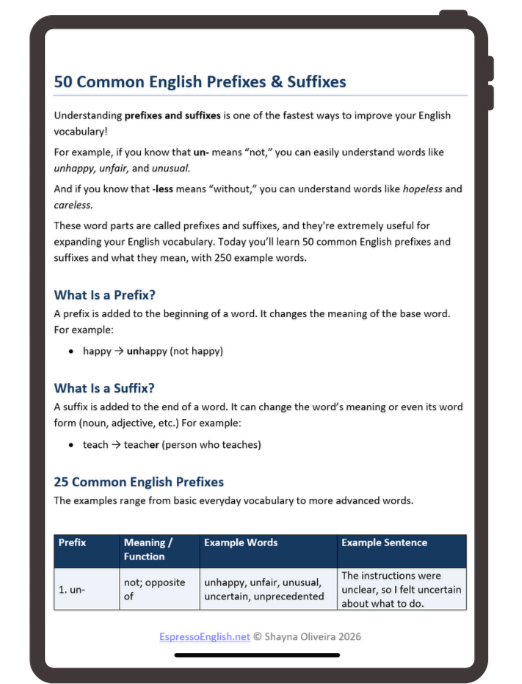
Understanding prefixes and suffixes is one of the fastest ways to improve your English vocabulary!
For example, if you know that un- means “not,” you can easily understand words like unhappy, unfair, and unusual.
And if you know that -less means “without,” you can understand words like hopeless and careless.
These word parts are called prefixes and suffixes, and they’re extremely useful for expanding your English vocabulary.
Today you’ll learn 50 common English prefixes and suffixes and what they mean, with 250 example words.
What Is a Prefix?
A prefix is added to the beginning of a word. It changes the meaning of the base word. For example:
- happy → unhappy (not happy)
What Is a Suffix?
A suffix is added to the end of a word. It can change the word’s meaning or even its word form (noun, adjective, etc.) For example:
- teach → teacher (person who teaches)
25 Common English Prefixes
The examples range from basic everyday vocabulary to more advanced words.
| Prefix | Meaning | 5 Example Words |
|---|---|---|
| 1. un- | not; opposite of | unhappy, unfair, unusual, uncertain, unprecedented |
| 2. re- | again; back | rewrite, reread, rebuild, reconsider, restructure |
| 3. dis- | not; opposite of; reverse | disagree, dislike, disconnect, discourage, disapprove |
| 4. pre- | before | preschool, preheat, preview, precaution, prerequisite |
| 5. mis- | wrongly; incorrectly | misspell, misunderstand, misbehave, misinterpret, misconstrue |
| 6. over- | too much; excessively | overeat, oversleep, overwork, overestimate, overcompensate |
| 7. under- | too little; below | underpaid, undercooked, underestimate, underdeveloped, underutilized |
| 8. non- | not; without | nonstop, nonfiction, nonstick, nonverbal, nonnegotiable |
| 9. in- / im- | not | incorrect, incomplete, impossible, impatient, imperceptible |
| 10. ir- | not | irregular, irrelevant, irresponsible, irreversible, irrefutable |
| 11. il- | not | illegal, illogical, illegible, illiterate, illegitimate |
| 12. anti- | against; opposing | antivirus, antiwar, antibacterial, antisocial, anticlimactic |
| 13. inter- | between; among | international, interact, interview, interconnected, interdisciplinary |
| 14. sub- | under; below | submarine, subway, subtitle, subconscious, subordinate |
| 15. super- | above; beyond; extremely | superhero, superstar, superhuman, supernatural, superimpose |
| 16. trans- | across; through | transport, transfer, transform, transcontinental, transatlantic |
| 17. auto- | self | autobiography, autograph, autopilot, autoimmune, autonomous |
| 18. bi- | two | bicycle, bilingual, biweekly, bilateral, bipartisan |
| 19. tri- | three | triangle, tripod, tricycle, trimester, trilateral |
| 20. multi- | many; multiple | multicolored, multitask, multicultural, multinational, multifaceted |
| 21. post- | after | postwar, postgame, postgraduate, postnatal, postindustrial |
| 22. ex- | former | ex-boyfriend, ex-wife, ex-president, ex-employee, ex-colleague |
| 23. co- | together; jointly | coworker, coauthor, copilot, cooperate, coexist |
| 24. semi- | half; partly | semicircle, semifinal, semisweet, semiconscious, semiformal |
| 25. micro- | small | microwave, microscope, microchip, microorganism, microeconomics |
25 Common English Suffixes
Noun Suffixes (Person / Thing / State)
| Suffix | Meaning / Function | 5 Example Words |
|---|---|---|
| 1. -er | person who does something | teacher, worker, driver, photographer, researcher |
| 2. -or | person who does something | actor, visitor, director, inventor, mediator |
| 3. -ist | person who practices or specializes in something | artist, dentist, scientist, journalist, environmentalist |
| 4. -ian | person associated with a field or activity | musician, magician, historian, politician, mathematician |
| 5. -ment | action, process, or result | payment, movement, agreement, achievement, disillusionment |
| 6. -ness | state or quality of | sadness, kindness, happiness, awareness, assertiveness |
| 7. -ity | state or quality of | ability, activity, equality, reliability, accountability |
| 8. -tion | action, process, or result | action, education, celebration, communication, implementation |
| 9. -sion | action, process, or state | decision, discussion, confusion, expansion, comprehension |
| 10. -ship | state, status, or relationship | friendship, membership, leadership, partnership, entrepreneurship |
| 11. -hood | state or condition | childhood, adulthood, parenthood, neighborhood, likelihood |
Adjective Suffixes
| Suffix | Meaning / Function | 5 Example Words |
|---|---|---|
| 12. -able | capable of being; suitable for | readable, washable, enjoyable, affordable, sustainable |
| 13. -ible | capable of being | possible, visible, flexible, reversible, comprehensible |
| 14. -ful | full of; having | helpful, careful, thankful, thoughtful, resourceful |
| 15. -less | without; lacking | careless, hopeless, useless, harmless, relentless |
| 16. -ous | full of; having a quality | famous, dangerous, nervous, courageous, contentious |
| 17. -ive | having a quality or tendency | active, creative, attractive, persuasive, counterproductive |
| 18. -al | relating to | personal, natural, musical, cultural, environmental |
| 19. -ic | relating to; characterized by | basic, artistic, historic, scientific, systematic |
| 20. -y | having; characterized by | rainy, sunny, dirty, cloudy, wealthy |
| 21. -ish | somewhat; resembling | childish, selfish, reddish, foolish, amateurish |
Verb Suffixes
| Suffix | Meaning / Function | 5 Example Words |
|---|---|---|
| 22. -ize (American) -ise (British) | make; become; cause to be | organize, modernize, memorize, prioritize, conceptualize |
| 23. -ify | make; cause to become | simplify, clarify, purify, intensify, exemplify |
| 24. -en | make; become | strengthen, widen, shorten, brighten, broaden |
| 25. -ate | make; cause; perform an action | activate, motivate, validate, differentiate, substantiate |
Why Prefixes and Suffixes Matter
When you learn word parts, you can often guess new vocabulary.
For example, consider the word unpredictable:
-
un- = not
-
predict = say what will happen
-
-able = capable
So the word unpredictable describes a situation where we cannot say what will happen in the future.
Even if you’ve never seen the word before, you can use its parts to understand it!