
What are homophones in English?
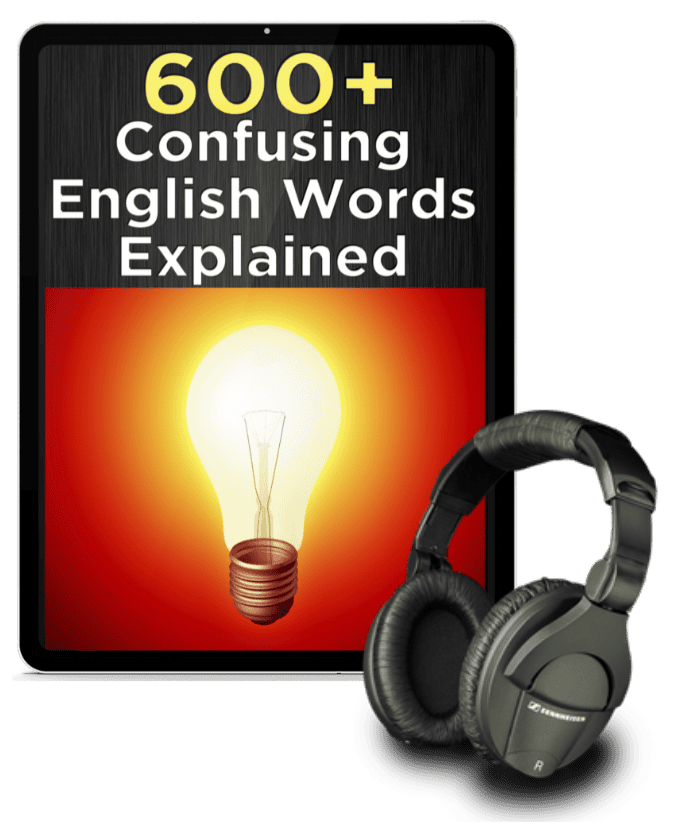
600+ Confusing Words Explained
Lots of English words sound exactly the same, but they have completely different meanings – like waste and waist, hear and here, piece and peace.
These are called homophones, and they confuse even advanced English learners. Native speakers often make mistakes with these, too!
In this lesson, I’ll quickly explain over 100 of the most common homophones in English, so you can finally keep them straight.
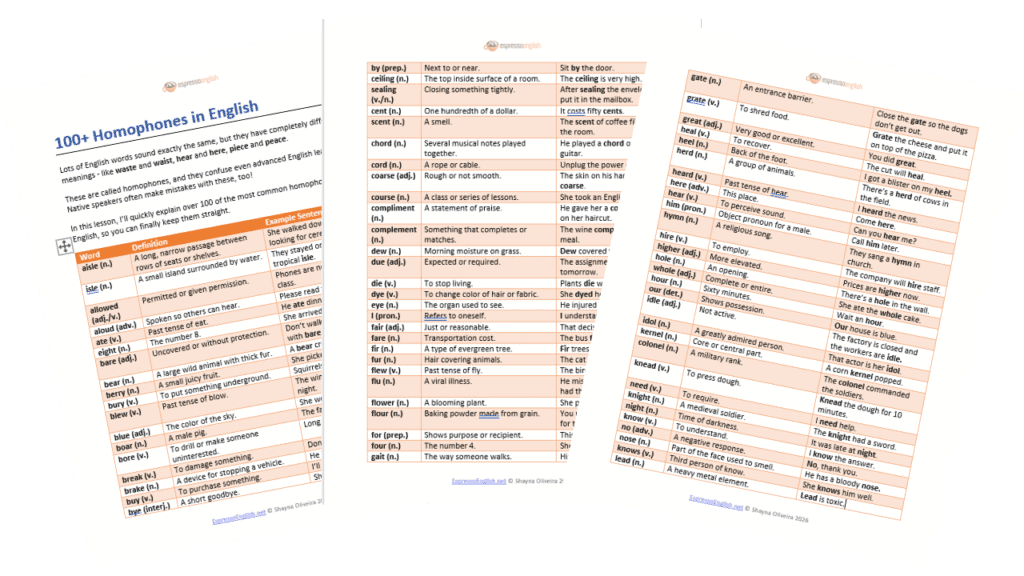
Want detailed explanations of MANY more words, plus lots of example sentences?
Get my e-book 600+ Confusing English Words Explained – in just a few minutes a day, all these confusing words will become clear to you, so you can use them confidently!
100 Homophones: List + Examples
| Word | Definition | Example Sentence |
| aisle (n.) | A long, narrow passage between rows of seats or shelves. | She walked down the aisle looking for cereal. |
| isle (n.) | A small island surrounded by water. | They stayed on a quiet tropical isle. |
| allowed (adj./v.) | Permitted or given permission. | Phones are not allowed in class. |
| aloud (adv.) | Spoken so others can hear. | Please read the text aloud. |
| ate (v.) | Past tense of eat. | He ate dinner early. |
| eight (n.) | The number 8. | She arrived at eight o’clock. |
| bare (adj.) | Uncovered or without protection. | Don’t walk on the hot sand with bare feet. |
| bear (n.) | A large wild animal with thick fur. | A bear crossed the road. |
| berry (n.) | A small juicy fruit. | She picked fresh berries. |
| bury (v.) | To put something underground. | Squirrels often bury acorns. |
| blew (v.) | Past tense of blow. | The wind blew hard all night. |
| blue (adj.) | The color of the sky. | She wore a blue dress. |
| boar (n.) | A male pig. | The farmer raised a boar. |
| bore (v.) | To drill or make someone uninterested. | Long meetings bore him. |
| break (v.) | To damage something. | Don’t break the glass. |
| brake (n.) | A device for stopping a vehicle. | He hit the brake suddenly. |
| buy (v.) | To purchase something. | I’ll buy the tickets. |
| bye (interj.) | A short goodbye. | She waved and said bye. |
| by (prep.) | Next to or near. | Sit by the door. |
| ceiling (n.) | The top inside surface of a room. | The ceiling is very high. |
| sealing (v./n.) | Closing something tightly. | After sealing the envelope, put it in the mailbox. |
| cent (n.) | One hundredth of a dollar. | It costs fifty cents. |
| scent (n.) | A smell. | The scent of coffee filled the room. |
| chord (n.) | Several musical notes played together. | He played a chord on the guitar. |
| cord (n.) | A rope or cable. | Unplug the power cord. |
| coarse (adj.) | Rough or not smooth. | The skin on his hands is coarse. |
| course (n.) | A class or series of lessons. | She took an English course. |
| compliment (n.) | A statement of praise. | He gave her a compliment on her haircut. |
| complement (n.) | Something that completes or matches. | The wine complements the meal. |
| dew (n.) | Morning moisture on grass. | Dew covered the lawn. |
| due (adj.) | Expected or required. | The assignment is due tomorrow. |
| die (v.) | To stop living. | Plants die without water. |
| dye (v.) | To change color of hair or fabric. | She dyed her hair. |
| eye (n.) | The organ used to see. | He injured his eye. |
| I (pron.) | Refers to oneself. | I understand. |
| fair (adj.) | Just or reasonable. | That decision was fair. |
| fare (n.) | Transportation cost. | The bus fare increased. |
| fir (n.) | A type of evergreen tree. | Fir trees grow here. |
| fur (n.) | Hair covering animals. | The cat has soft fur. |
| flew (v.) | Past tense of fly. | The bird flew away. |
| flu (n.) | A viral illness. | He missed work because he had the flu. |
| flower (n.) | A blooming plant. | She picked a flower. |
| flour (n.) | Baking powder made from grain. | You need two cups of flour for the cake. |
| for (prep.) | Shows purpose or recipient. | This gift is for you. |
| four (n.) | The number 4. | She has four dogs. |
| gait (n.) | The way someone walks. | His gait looked uneven. |
| gate (n.) | An entrance barrier. | Close the gate so the dogs don’t get out. |
| grate (v.) | To shred food. | Grate the cheese and put it on top of the pizza. |
| great (adj.) | Very good or excellent. | You did great. |
| heal (v.) | To recover. | The cut will heal. |
| heel (n.) | Back of the foot. | I got a blister on my heel. |
| herd (n.) | A group of animals. | There’s a herd of cows in the field. |
| heard (v.) | Past tense of hear. | I heard the news. |
| here (adv.) | This place. | Come here. |
| hear (v.) | To perceive sound. | Can you hear me? |
| him (pron.) | Object pronoun for a male. | Call him later. |
| hymn (n.) | A religious song. | They sang a hymn in church. |
| hire (v.) | To employ. | The company will hire staff. |
| higher (adj.) | More elevated. | Prices are higher now. |
| hole (n.) | An opening. | There’s a hole in the wall. |
| whole (adj.) | Complete or entire. | She ate the whole cake. |
| hour (n.) | Sixty minutes. | Wait an hour. |
| our (det.) | Shows possession. | Our house is blue. |
| idle (adj.) | Not active. | The factory is closed and the workers are idle. |
| idol (n.) | A greatly admired person. | That actor is her idol. |
| kernel (n.) | Core or central part. | A corn kernel popped. |
| colonel (n.) | A military rank. | The colonel commanded the soldiers. |
| knead (v.) | To press dough. | Knead the dough for 10 minutes. |
| need (v.) | To require. | I need help. |
| knight (n.) | A medieval soldier. | The knight had a sword. |
| night (n.) | Time of darkness. | It was late at night. |
| know (v.) | To understand. | I know the answer. |
| no (adv.) | A negative response. | No, thank you. |
| nose (n.) | Part of the face used to smell. | He has a bloody nose. |
| knows (v.) | Third person of know. | She knows him well. |
| lead (n.) | A heavy metal element. | Lead is toxic. |
| led (v.) | Past tense of lead. | She led the team. |
| leak (n./v.) | Escape of liquid. | The pipe has a leak. |
| leek (n.) | A vegetable. | Add chopped leek to the soup. |
| loan (n.) | Borrowed money. | He took a loan. |
| lone (adj.) | Single or alone. | A lone tree stood in the desert. |
| made (v.) | Past tense of make. | She made dinner. |
| maid (n.) | A cleaning worker. | The maid cleaned the room. |
| mail (n.) | Letters and packages. | The mail arrived. |
| male (adj.) | Not female. | The male lion roared. |
| medal (n.) | An award. | She won a medal. |
| meddle (v.) | To interfere. | Don’t meddle in your adult children’s lives. |
| meet (v.) | To encounter. | Let’s meet tomorrow. |
| meat (n.) | Animal food. | He’s a vegetarian; he doesn’t eat meat. |
| miner (n.) | A person who mines. | The miner worked underground. |
| minor (adj.) | Small or less important. | It’s only a minor issue. |
| morning (n.) | Early part of the day. | Good morning. |
| mourning (n.) | Showing grief. | The family is mourning the death of their grandmother. |
| new (adj.) | Not old. | She bought a new car. |
| knew (v.) | Past tense of know. | I raised my hand because I knew the answer. |
| none (pron.) | Zero amount. | None were left. |
| nun (n.) | A religious woman. | The nun prayed quietly. |
| one (n.) | The number 1. | She has one sister. |
| won (v.) | Past tense of win. | They won the game. |
| pail (n.) | A bucket. | He carried a pail of water. |
| pale (adj.) | Light in color; lacking color. | Her face looked pale. |
| pain (n.) | Sensation of hurt | He felt a sharp pain in his back. |
| pane (n.) | A single sheet of glass in a window. | A pane of glass cracked in the storm. |
| pair (n.) | Two things that belong together. | I bought a pair of gloves. |
| pear (n.) | A sweet fruit with a rounded shape. | She ate a ripe pear. |
| past (n./adj.) | Time before now; earlier. | We can’t change the past. |
| passed (v.) | Past tense of pass. | She passed the test easily. |
| pause (n./v.) | A short stop or break. | Pause the video so you can take some notes. |
| paws (n.) | The feet of animals like cats and dogs. | The puppy’s paws were muddy. |
| peace (n.) | Calm; no conflict. | The warring countries finally made a peace treaty. |
| piece (n.) | A part of something. | Can I have a piece of cake? |
| peak (n.) | The highest point. | They reached the peak of the mountain at noon. |
| peek (v./n.) | A quick look. | She took a quick peek inside the store. |
| plain (adj.) | Simple; not decorated or fancy. | He prefers plain clothes. |
| plane (n.) | An airplane. | The plane landed on time. |
| pour (v.) | To make liquid flow from a container. | Pour the water slowly. |
| poor (adj.) | Having little money; not rich. | They grew up poor, without enough to eat. |
| pray (v.) | To speak to a god; to ask spiritually. | They pray every morning. |
| prey (n.) | An animal hunted by another animal. | The hawk circled above its prey. |
| principal (n.) | The head of a school. | The principal called a meeting. |
| principle (n.) | A basic rule or belief. | Honesty is an important principle. |
| rain (n./v.) | Water that falls from the sky. | Rain is expected this afternoon. |
| reign (n./v.) | The period a ruler is in power; to rule. | The emperor’s reign lasted thirty years. |
| raise (v.) | To lift; to increase. | They plan to raise prices. |
| rays (n.) | Beams of light. | Rays of sunlight came through the window. |
| read (v.) | Past tense of “read” – to look at written words for meaning. | I read the article last night. |
| red (adj.) | A color. | She wore a red scarf. |
| right (adj./n.) | Correct; or the direction opposite left. | Turn right at the corner. |
| write (v.) | To form letters or words. | Please write your name here. |
| ring (n./v.) | A circular band; or a bell sound. | He gave her a ring. |
| wring (v.) | To twist tightly to remove liquid. | Wring out the wet towel. |
| road (n.) | A street or route for vehicles. | The car stopped on the side of the road. |
| rode (v.) | Past tense of ride. | She rode her bike downtown. |
| role (n.) | A function or part in a situation. | He played a key role on the team. |
| roll (v./n.) | To turn over in a circular motion. | The ball rolled down the hill. |
| sail (n./v.) | A boat’s cloth that catches wind; to travel by boat. | The sail filled with wind. |
| sale (n.) | The act of selling; often a discount event. | The store is having a sale. |
| scene (n.) | A place or part of a story or event. | The opening scene was dramatic. |
| seen (v.) | Past participle of see. | I’ve seen that movie before. |
| sea (n.) | A large body of salt water. | We swam in the sea. |
| see (v.) | To look at; to understand. | Glasses help me see clearly. |
| sell (v.) | To exchange something for money. | She wants to sell her car. |
| cell (n.) | A small room; or the basic unit of living things. | The prisoner stayed in a cell. |
| sent (v.) | Past tense of send. | I sent the email yesterday. |
| scent (n.) | A smell. | The scent of flowers was strong. |
| sew (v.) | To stitch with needle and thread. | She learned to sew a button. |
| so (adv./conj.) | Therefore, or very | It was late, so we left. I was so tired. |
| shore (n.) | Land next to a lake or ocean. | They walked along the shore. |
| sure (adj.) | Certain; confident. | I’m sure this is correct. |
| sight (n.) | The ability to see. | His sight improved after surgery. |
| site (n.) | A location or place. | The building site is closed. |
| some (det./pron.) | An unspecified amount. | I need some help with this. |
| sum (n.) | A total amount. | The sum of all the repairs was larger than expected. |
| son (n.) | A male child. | Their son is in college. |
| sun (n.) | The star that lights Earth. | The sun is bright today. |
| soul (n.) | The spiritual part of a person. | Music can touch the soul. |
| sole (n./adj.) | The bottom of a foot/shoe; or only one. | The sole of my shoe is worn out. She was the sole survivor of the accident. |
| stair (n.) | One step in a staircase. | He sat on the bottom stair. |
| stare (v.) | To look at something for a long time. | Everyone stared at the person in the strange costume. |
| stationary (adj.) | Not moving. | The car remained stationary. |
| stationery (n.) | Paper and writing supplies. | She bought nice stationery for writing letters. |
| steal (v.) | To take something illegally. | Someone tried to steal my bag. |
| steel (n.) | A strong metal. | The bridge is made of steel. |
| steak (n.) | A cut of meat. | He ordered a steak for dinner. |
| stake (n.) | A share/interest; or a pointed post. | She has a stake in the business. |
| suite (n.) | A set of connected rooms. | They upgraded to a hotel suite. |
| sweet (adj.) | Sugary in taste; or pleasant. | The cake was very sweet. |
| tail (n.) | The back part of an animal’s body. | The dog wagged its tail. |
| tale (n.) | A story, often imaginative. | He told a funny tale. |
| tears (n.) | Drops of liquid from your eyes when crying. | Tears ran down her face. |
| tiers (n.) | Levels or rows, one above another. | The seats were arranged in tiers. |
| threw (v.) | Past tense of throw. | He threw the ball hard. |
| through (prep./adv.) | From one side to the other. | We walked through the tunnel. |
| toe (n.) | A part of the foot. | I stubbed my toe. |
| tow (v.) | To pull a vehicle or object. | The truck will tow your car. |
| vain (adj.) | Too proud of appearance; or pointless. | He’s vain about his looks. All my efforts to fix the TV were in vain. |
| vein (n.) | A blood vessel. | The nurse found a vein quickly. |
| waste (v./n.) | To use carelessly; or unused material. | Don’t waste your time. |
| waist (n.) | The middle part of the body. | These pants are too loose in the waist; I need a belt. |
| way (n.) | A path or method. | This is the best way to do it. |
| weigh (v.) | To measure weight. | Please weigh the package. |
| weak (adj.) | Not strong. | I felt weak after the flu. |
| week (n.) | Seven days. | I’ll see you next week. |
| wear (v.) | To have clothing on your body. | It’s cold; wear a jacket. |
| where (adv.) | Used to ask about location. | Where are my keys? |
| weather (n.) | Conditions like rain, wind, or sun. | The weather changed quickly. |
| whether (conj.) | Introduces a choice or uncertainty. | I don’t know whether to go. |
| which (pron./det.) | Used to ask about choice. | Which one do you prefer? |
| witch (n.) | A woman with magical powers. | The witch lived in the forest. |
| whose (pron./det.) | Used to ask or say who owns something. | Whose book is this? |
| who’s (contraction) | Short for “who is” or “who has.” | Who’s coming to dinner? |
| wood (n.) | Material from trees. | The chair is made of wood. |
| would (modal v.) | Used for polite requests or hypothetical situations. | I would like a coffee, please. |
| yoke (n.) | A device that connects things (often animals or parts). | The ox wore a wooden yoke. |
| yolk (n.) | The yellow part of an egg. | You’ll need three egg yolks for this recipe. |
| you (pron.) | Refers to the person being spoken to. | You did a great job. |
| ewe (n.) | A female sheep. | The ewe stayed near her lamb. |
| your (determiner) | Belonging to you. | Is this your notebook? |
| you’re (contraction) | Short for “you are.” | You’re doing well. |