
Stop saying very tired, very big, very good…
Instead, you can use a better, stronger, more precise word.
Today I’ll teach you how to upgrade 20 adjectives so that your vocabulary will be very good… I mean, excellent!
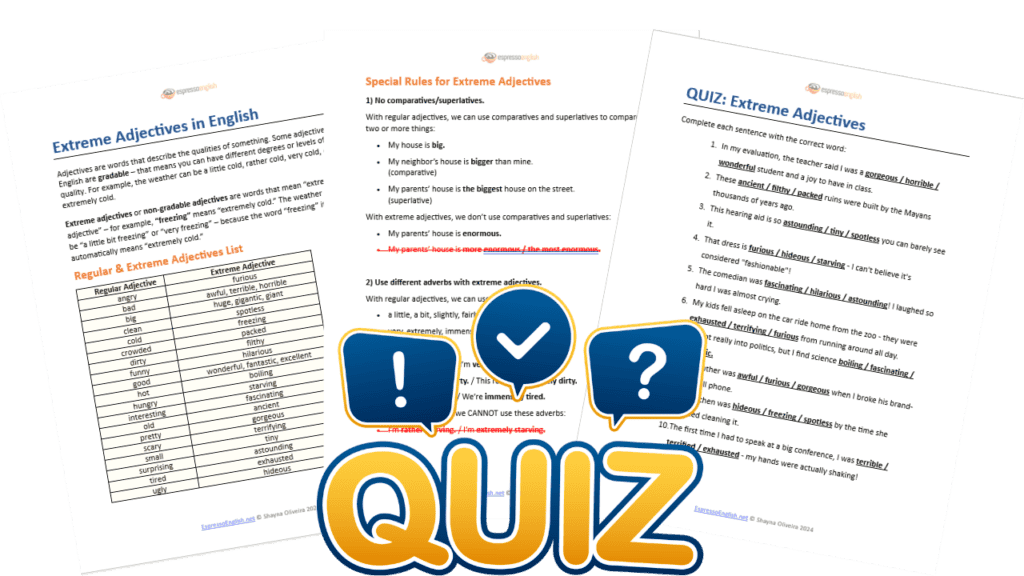
To learn more, you can download my free guide to extreme adjectives in English – which includes a quiz to test yourself.
Very + Adjective → Strong Adjective
- Very tired → exhausted
“I worked 12 hours today — I’m exhausted.” - Very hungry → starving / ravenous
“I skipped lunch, I’m starving!”
“The kids were ravenous after a full day at the park.” - Very big → huge, gigantic, enormous, immense
“They live in a huge house.”
“The tutoring made an enormous difference in his grades.” - Very small → tiny, minuscule
“The bedroom was tiny — there was barely enough space for a bed!”
“There’s a minuscule scratch on the car.” - Very good → excellent, fantastic, incredible, terrific
“She did a fantastic job on the project.” - Very bad → terrible, horrible
“He was kicked out of school for his terrible behavior.” - Very old → ancient
“We saw the ruins of an ancient temple.” - Very funny → hilarious
“The movie was hilarious. I couldn’t stop laughing” - Very angry → furious
“She was furious when her boyfriend flirted with another woman.” - Very scared → terrified, petrified
“I won’t go on the hot air balloon ride because I’m terrified of heights.” - Very interesting → fascinating, captivating
“The book was fascinating. I couldn’t put it down” - Very beautiful → gorgeous, stunning, breathtaking
“There are some stunning beaches on the west coast.” - Very surprised → astonished, astounded
“I was astonished that a 7-year-old broke the world record.” - Very unpleasant → disgusting, repulsive, revolting
“I hate mushrooms; I find them revolting.” - Very unusual → extraordinary, unprecedented, bizarre (negative connotation)
“He’s shown extraordinary improvement in his English – I wonder what he’s doing differently?” - Very important → essential, crucial, vital
“It is crucial for hospital rooms to be clean.” - Very loud → deafening
“The music at the outdoor concert was deafening.” - Very smart → brilliant
“He’s a brilliant scientist.” - Very cute → adorable
“The puppies are absolutely adorable.” - Very sure → certain, positive, convinced
“I’m positive that my courses and e-books will help you become more fluent in English.”
So instead of using “very + adjective,” try using one of these strong adjectives instead.
It’s a simple change — but it makes you sound a lot more fluent!
Remember to download your free PDF guide + quiz here.
If you’d like to level up your vocabulary even more, check out my Advanced Vocabulary and Collocations Course. You’ll learn tons of high-level words and how to put them together naturally like a native speaker!