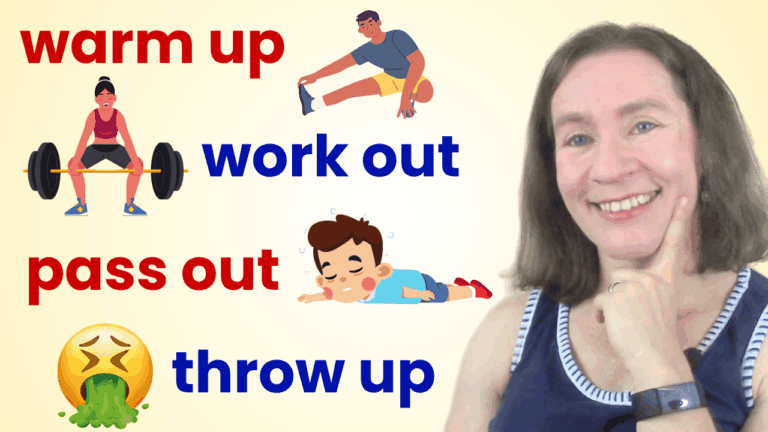
English has LOTS of phrasal verbs with “up” – and in this video, I’ll teach you 50 of them. Some are easier to understand, like “clean up” or “dress up” – but others are trickier and not so obvious, like “crop up” or “whip up.”
By the end of this lesson, you’ll not only know what these phrasal verbs mean, but you’ll also see them in clear example sentences so you can start using them in your own English.
We’ll start with 25 of the simpler phrasal verbs, and then move on to the more advanced ones. Ready to start?
Simple Phrasal Verbs with UP
Fix up – repair or improve something.
- They spent the weekend fixing up the old house.
Follow up – take further action after something has happened.
- The manager promised to follow up on my complaint.
Look up to (someone) – admire or respect someone.
- She has always looked up to her older sister.
Speak up – talk louder so people can hear.
- Please speak up; I can’t hear you in the back.
Grow up – become an adult.
- He grew up in a small town in Texas.
Hurry up – go faster.
- Hurry up, or we’ll miss the train!
Clean up – make something clean or tidy.
- We need to clean up the kitchen after dinner.
Think up – invent or imagine an idea.
- She thought up a clever plan to surprise her friend.
Save up – collect money for something.
- He’s saving up to buy a new car.
Beat up – attack someone violently.
- The bully threatened to beat up the smaller kids.
Pick up – lift something OR go get someone from a place.
- Please pick up the toys on the floor.
- Can you pick up the kids from school today?
Look up – search for information (often in a book or online).
- I need to look up the meaning of this word in the dictionary.
Cheer up – become happier.
- She bought him ice cream to cheer him up after the bad news.
Light up – illuminate OR smile happily.
- Her face lit up when she saw her best friend.
Fill up – make something full.
- Let’s fill up the car before we go on the trip.
Pack up – put things away in a bag or box.
- We packed up our picnic and went home.
Set up – arrange or organize.
- They set up chairs for the outdoor concert.
Come up – arise/appear (an issue, a problem, a topic of conversation).
- Something important came up, so I had to cancel the meeting.
Show up – appear or arrive.
- She didn’t show up to work – she might be sick.
Dress up – put on nice or fancy clothes.
- Everyone dressed up for the wedding.
Break/split up – end a relationship.
- They decided to break up after three years together.
Catch up – reach the same level OR reconnect.
- I ran fast to catch up with my friends.
- Let’s have coffee and catch up soon.
Give up – quit, stop trying.
- Don’t give up—you’re almost finished!
Keep up – maintain the same pace.
- He walks so fast that I can’t keep up with him.
Line up – arrange in a row OR stand in a line.
- The students lined up outside the classroom.
How many of those did you know, and which ones were new to you? If you thought that section was too easy, let’s look at some more advanced phrasal verbs with “up.”
And if you want to learn even more phrasal verbs in a natural way, through conversations, then you’ll love my Phrasal Verbs in Conversation Course!
It’s one of our most popular courses because it makes learning and practicing these common phrasal verbs so easy.

More Advanced Phrasal Verbs with UP
All right, ready for the trickier phrasal verbs? Let’s dive in.
Bring up – mention a topic.
- She brought up the idea of moving abroad during dinner.
Make up – invent (a story) OR reconcile after a fight.
- He made up an excuse for being late.
- They argued yesterday but made up this morning.
Take up – start a hobby OR occupy space/time.
- She took up painting as a relaxing hobby.
- That sofa takes up too much space in the living room.
Hold up – delay someone/something.
- Sorry I’m late — I was held up in traffic.
Crack up – burst out laughing OR (informal) have a mental breakdown.
- The comedian’s joke made the whole audience crack up.
- After months of stress, he nearly cracked up.
Throw up – vomit
- My daughter got carsick and threw up.
Divvy up – divide and share.
- Let’s divvy up the bill so everyone pays their share.
Mix up – confuse two things or people.
- I always mix up “affect” and “effect.”
Mess up – do something badly, spoil.
- He messed up the report by forgetting to include the data.
Perk up – become more lively or cheerful.
- She perked up after drinking some coffee.
Tense up – become physically tight or nervous.
- He always tenses up before giving a speech.
Touch up – make small improvements.
- She touched up her makeup before the party.
Clear up – resolve a misunderstanding OR (weather) become sunny.
- I hope this meeting clears up any confusion.
- The sky cleared up by the afternoon.
Blow up – explode OR become very angry.
- The bomb blew up near the bridge.
- She blew up at her coworker during the meeting.
Warm up – prepare before exercise or performance.
- The athletes warmed up before the race.
- The singer warmed up her voice before going on stage.
Crop up – appear unexpectedly.
- Problems often crop up when you least expect them.
Flare up – suddenly worsen (pain, violence, anger).
- His back pain flared up again after lifting boxes.
Whip up – quickly prepare (especially food) OR provoke/cause emotions.
- She whipped up some pancakes for breakfast.
- The politician tried to whip up anger among the crowd.
Draw up – prepare a formal document/plan.
- The lawyer drew up the contract yesterday.
Step up – increase effort or take responsibility.
- It’s time for you to step up and lead the team.
Live up to – meet expectations/standards.
- The movie didn’t live up to all the hype.
Pass up – decline an opportunity.
- He passed up the job offer because it required too much travel.
Ease up – become less severe OR relax.
- The teacher eased up on the homework after complaints.
- You should ease up and take a break—you’ve been working too hard.
Wrap up – finish or conclude.
- Let’s wrap up the meeting before lunch.
Sum up – give a summary or conclusion.
- To sum up, we need more time and resources to complete the project.
Well, I’m about to wrap up this video – but don’t pass up the opportunity to learn more!
Continue learning inside my Phrasal Verbs in Conversation Course.